
INTRODUCTION
By 2026, Bitcoin mining has moved beyond the idea of a digital gold rush. It's now seen as a developed part of industrial energy management. With global hash rates going up and the network difficulty changing to match newer hardware, there’s no longer any room for mistakes in operations. Success in today’s market is no longer dictated solely by the acquisition of the latest ASICs, but by the efficiency of the environment in which they operate.
For U.S.-based investors and enterprise operators, the focus has shifted toward institutional-grade reliability, where energy curtailment strategies, heat reclamation, and high-density hydro cooling are the primary levers for maintaining a competitive edge.
Understanding the Technical Architecture of Modern Bitcoin Mining and the Rapid Rise of Hydro-Cooled Systems
For smaller mining setups, air-cooled methods still work well. However, for larger, more professional operations, the standard has definitely shifted to hydro-thermal systems. Hardware like the Antminer S21 and S23 Hydro series changes how we think about heat. These machines can put out over 250 terahashes per second, but they create a lot of heat. Getting rid of that heat with regular fans would make a lot of noise and use up too much power.
Exploring the Hydro Cooling Advantage for High-Density ASIC Mining Operations
Hydro-cooled systems utilize a closed-loop liquid circuit to transfer heat away from the hash boards more effectively than air. This allows for:
Achieving Maximum Thermal Consistency and Longevity in Hydro-Cooled ASIC Rigs
Liquid cooling eliminates the hot spots common in air-cooled racks, ensuring that all chips within the ASIC operate at a uniform temperature, which significantly reduces the rate of semiconductor degradation.
Benefits of Operational Silence and Achieving Higher Rack Density in Data Centers
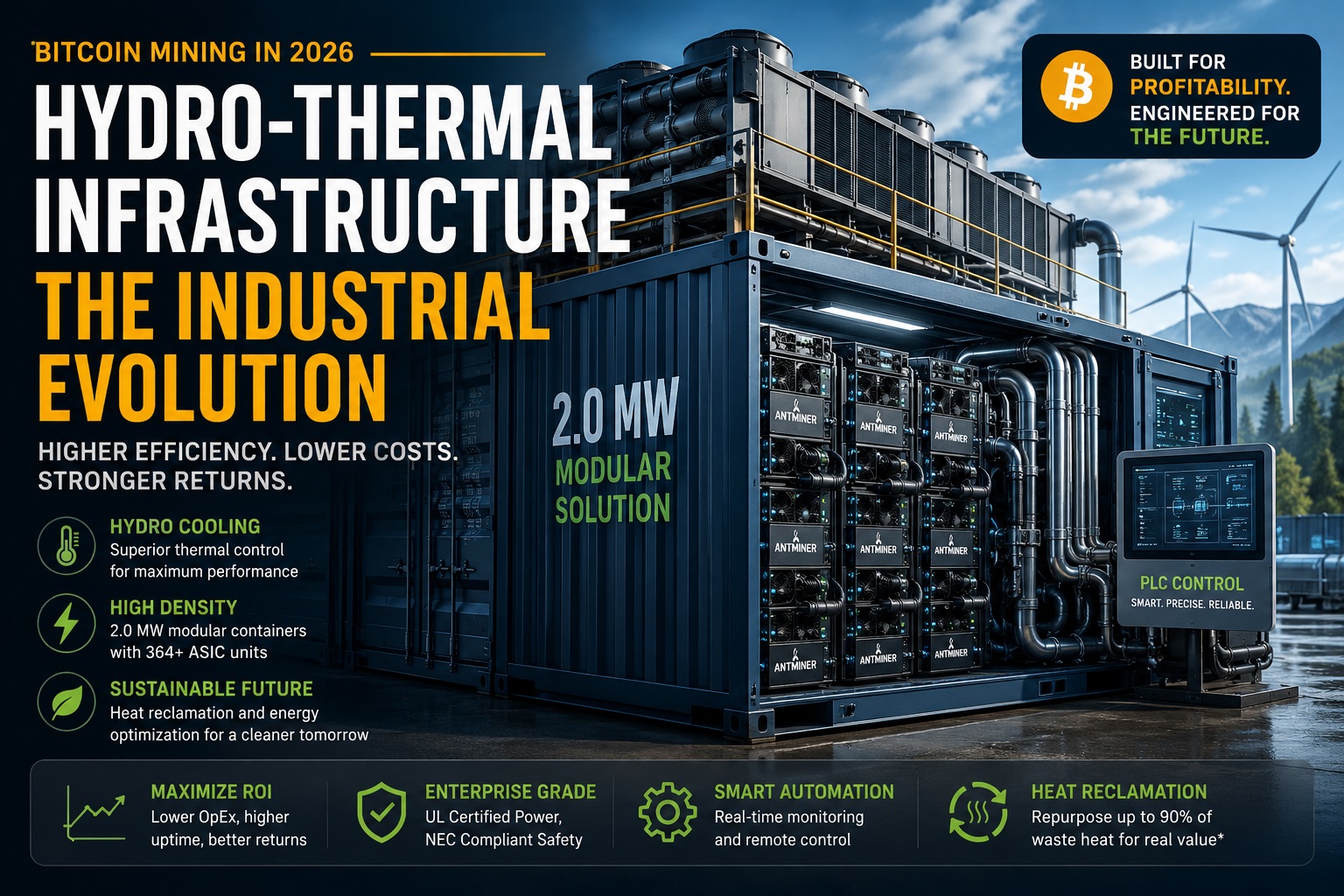
When you take out those big, fast-spinning fans, you can fit a lot more into your rack. A standard 40HQ container setup can now hold more than 360 units. This approach lets us get 10 MW of computing power into half the area it used to take.
Analyzing the Environmental Versatility of Industrial Hydro Cooling Systems Across Harsh Climates
Modern cooling distribution units, which happen to be managed by PLCs, enable systems to function well even in harsh climates, from -20°C to 45°C. This is achieved by using variable frequency drives on external dry coolers to keep the internal thermal equilibrium quite precise.
Why Enterprise-Grade Mining Infrastructure is Moving Toward the 2.0 MW Modular Standard
For 2026 deployments, the industry has gravitated toward a dual-container modular architecture. This setup separates the power and cooling distribution from the actual mining hardware to maximize airflow and safety.
| Component | Specification | Operational Impact |
|---|---|---|
| Miner Capacity | 364 Units (S19/S21/S23 Hydro) | High-density throughput for rapid ROI. |
| Power Distribution | 2400A Smart PDC (UL Certified) | Real-time monitoring with automated trip settings. |
| Cooling Capacity | >2000kW (Dry Cooler + Evaporative) | Redundant heat rejection for summer peaks. |
| Control System | Integrated PLC Console | Remote management and automated fan/pump adjustment. |
| Protection | NEC/UL Compliant SPD & Thermal Overload | Essential for insurance and regulatory approval. |
Developing an Investment Strategy for ASIC Mining in 2026 to Maximize ROI Beyond the Hash Rate
When evaluating an entry into enterprise mining in 2026, investors must look past the sticker price of the ASIC. The real capital expenditure (CapEx) involves the infrastructure that protects the hardware. While a 2 MW hydro-cooled container solution carries a significant upfront cost, the long-term operational expenditure (OpEx) is vastly superior.
Reducing Energy Efficiency Losses and Eliminating "Parasitic" Power Consumption
Air-cooled miners often use 5–8% of their power just to run their fans. Hydro systems reroute that power back into hashing. Looking at a typical hardware cycle of three years, a small 5% gain in efficiency can lead to a return of hundreds of thousands of dollars.
Enhancing the Secondary Market Resilience and Resale Value of Hydro-Cooled ASICs
When the market gets more established, hydro-cooled ASICs tend to hold their resale value better than those using air cooling. This happens because the machines experience less thermal stress. When considering investments, it's worth noting that hydro-cooled hardware tends to hold its value well in secondary markets, positioning it as a premium asset.
Critical Site Selection Factors and Navigating Regulatory Moats in the United States
In the United States, site selection is now a matter of regulatory strategy. Operators are increasingly looking for locations where they can provide "Demand Response" services to the grid. Because hydro-cooled containers are modular and digitally controlled via PLC, they can be powered down or throttled in seconds to stabilize local grids, often earning the operator significant energy credits that lower the effective cost per kilowatt-hour.
Implementing Effective Risk Management in High-Density Hydro-Cooled Mining Environments
Despite the technical prowess of hydro cooling, it introduces specific single-point-of-failure risks that must be managed through rigorous engineering:
• If a pump stops working in a 2 MW loop, the system can overheat quite quickly. We need to think about what this means for fluid dynamics. Redundancy is important to keep things running smoothly. For enterprise systems, it's essential to have dual-pump redundancies. These work with automated shut-off mechanisms in the power distribution unit to immediately stop power if the coolant flow goes below a set point.
• Using unconditioned water in a hydro loop can lead to real problems with water quality and calcification. Scaling and mineral buildup can lead to clogs in the micro-channels of ASIC cold plates. For modern systems, using a closed-loop setup with distilled water and glycol-based inhibitors is crucial for long-term endurance.
Conclusion: The Strategic Outlook for Industrial Bitcoin Mining and Data Center Evolution in 2026
As we navigate 2026, the era of amateur industrial mining has concluded. The transition to hydro-cooled, containerized solutions represents the professionalization of the industry. For the serious investor, these systems offer a robust defense against the volatility of the crypto market by maximizing hardware lifespan and minimizing electricity waste. Profitability in this epoch is a game of millimeters. By integrating smart PDCs, PLC-controlled cooling, and high-density modular designs, operators are no longer just mining crypto—they are running high-tech, energy-efficient data centers built for the future.