
Introduction
The show where conviction meets reality, and reality points straight to Bitcoin.
I'm your host, Hurley.
Let’s dive into the mechanics of what we are witnessing because silver doesn't usually move with this kind of predatory aggression; it doesn't typically drift or grind, and it certainly doesn't explode unless something deep within the plumbing of the global financial system is under immense, perhaps terminal, stress.
Silver is a fascinatingly strange asset that sits right at the intersection of monetary history, industrial necessity, massive leverage, and retail speculation.
Because its markets are significantly smaller and more opaque than gold—and notoriously more heavily shorted—violent moves in silver act as a high-velocity stress test for the entire system.
When silver breaks out like it has this month, it isn't merely "price discovery" in a vacuum; it is a signal that the counterparty risk inherent in paper markets is becoming untenable, forcing us to ask the uncomfortable question:
What happens if silver doesn't just rally, but forces a systemic failure on the other side of the trade?
How Gold and Silver Act as Early Warning Signals for Fiat System Stress and Sovereign Debt Crisis
Historically, gold tends to confirm that monetary stress exists, but silver is the one that exposes the cracks in the leverage.
Today, both are flashing red simultaneously, and this isn't just theoretical anxiety—you can point directly to the cracks in sovereign balance sheets, specifically in Japan.
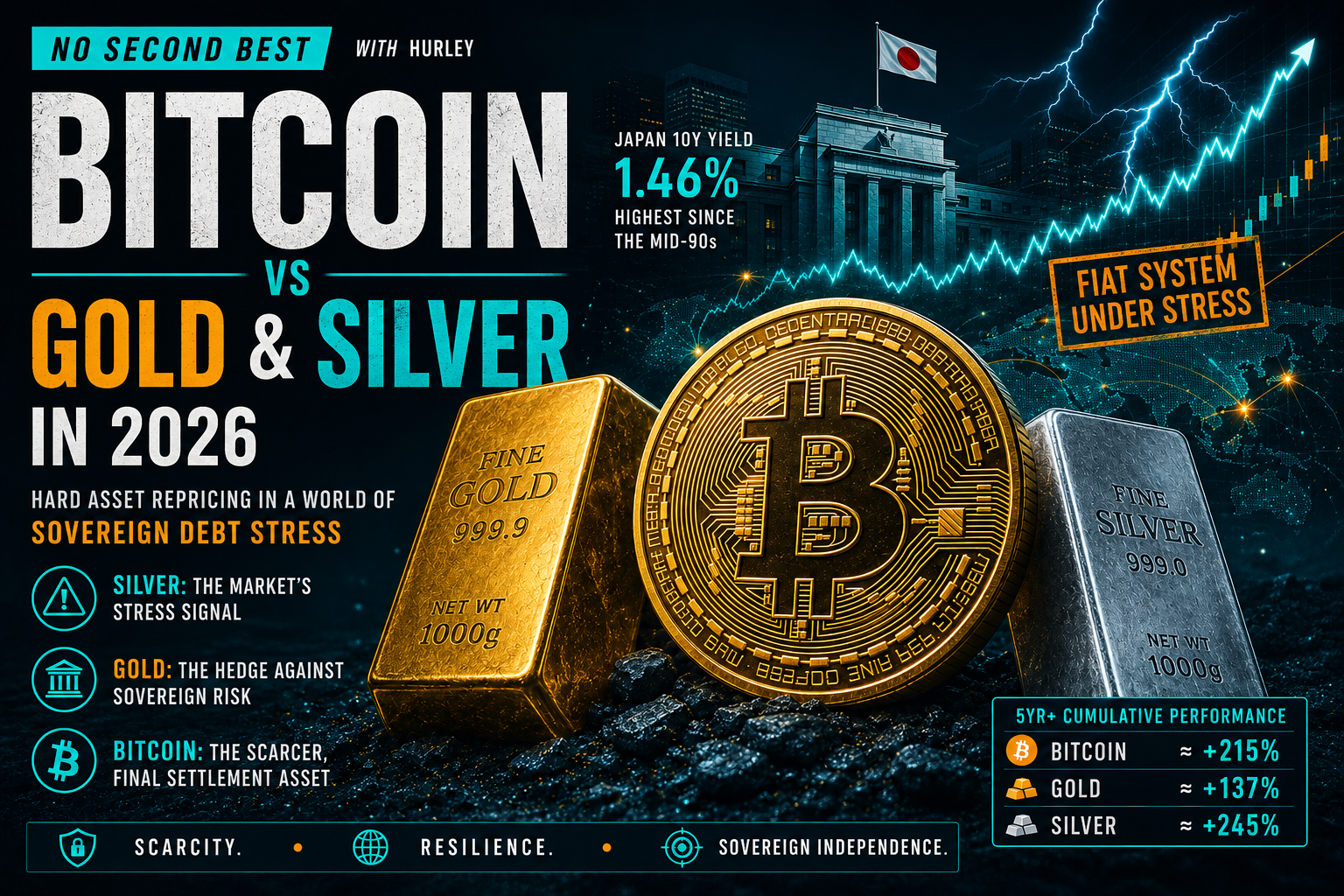
With the highest debt-to-GDP ratio in the developed world and a central bank that has spent decades as the world's most aggressive money printer, Japan is now watching government bond yields hit levels not seen since the mid-90s, signaling that the bond market is finally pushing back against decades of manipulation.
As the yen becomes the canary in the coal mine for all fiat currencies, we see that gold and silver aren't reacting to transient inflation headlines; they are reacting to the reality of sovereign insolvency.
-
Gold: up over 80% in a year
-
Silver: up approximately 200%
-
Bitcoin: four consecutive months of decline
Analyzing Bitcoin vs. Gold in 2026: Navigating the Cyclical Bleed Phase and Price Divergence
While monetary metal maxis are taking victory laps, we need to zoom out and look at the actual architecture of wealth.
Since 2019:
-
Bitcoin: ≈ +1300%
-
Silver: ≈ +588%
-
Gold: ≈ +300%
The real question isn't:
"What's wrong with Bitcoin?"
The question is:
Why does Bitcoin always feel the worst right before it matters the most?
Performance Comparison
| Period | Bitcoin (BTC) | Gold (XAU) | Silver (XAG) | Market Context |
|---|---|---|---|---|
| 2021 | +59.7% | -3.6% | -11.5% | Post-Halving Surge |
| 2022 | -64.3% | -0.2% | +2.8% | Global Deleveraging |
| 2023 | +155.4% | +13.5% | -0.6% | Banking Crisis |
| 2024 | +121.1% | +27.2% | +35.6% | ETF Adoption |
| 2025 | -6.4% | +65.2% | +144.7% | Fiat Stress |
| 2026 (YTD) | +2.1% | +19.2% | +48.0% | Sovereign Yields |
| Cumulative (5yr+) | ≈ +215% | ≈ +137% | ≈ +245% | Asset Repricing |
The Mechanics of Strategic Asset Repricing
As I’ve pointed out previously, Bitcoin is currently in a bear market when priced in gold, not dollars.
This reflects a recurring cyclical pattern where Bitcoin bleeds against gold for roughly 14 months before a violent reversal.
January 2026 marks that 14th month.
This is the accumulation phase:
-
Boring
-
Frustrating
-
Designed to destroy weak-handed conviction
Yet historically, it becomes the most opportunistic phase for those who understand protocol-level scarcity.
Is Bitcoin Really a Fiat Currency?
Debunking the Peter Schiff Argument Against Digital Gold
On a recent appearance with Tucker Carlson, Peter Schiff attempted to categorize Bitcoin as a "fiat" currency.
His argument:
-
Bitcoin is backed only by faith
-
It follows the "greater fool theory"
But technically:
Fiat comes from the Latin fiat — “let it be done.”
Fiat refers to money created by decree and authority.
Bitcoin is presented here as the opposite:
- No issuer
- No committee
- No supply discretion
- No central authority
Unlike physical silver, where large liquidations involve:
- Wider spreads
- Dealer discounts
- Physical settlement friction
Bitcoin remains:
- Global
- Digital
- 24/7 tradable
- Highly liquid
The ASIC Energy Wall
Understanding How Bitcoin’s Proof-of-Work Protocol Secures the World’s Hardest Money
For those active in the mining industry:
Bitcoin’s value proposition is framed around the ASIC energy wall.
While gold mining scales with incentives, Bitcoin’s difficulty adjustment fixes issuance regardless of computational expansion.
Fixed Supply
Unlike silver:
-
Rising prices increase mining activity
-
Scrap recovery expands supply
Bitcoin issuance remains capped.
Liquidity
You can move:
- $100 million in BTC
- Globally
- Within minutes
Attempting the same with 1,000 ounces of silver introduces:
-
Logistics
-
Counterparty risk
-
Tax and transport friction
Proof of Work
The argument presented:
Intrinsic value emerges from the exahashes securing the network.
Bitcoin is framed as:
The most powerful and unhackable computing network in human history.
The Future of Hard Asset Allocation
Transitioning from Speculator to Sovereign Bitcoin Holder
The market noise is deafening.
But the signal becomes harder to ignore.
Perhaps we are not watching the end of the fiat experiment—
but we may be witnessing one of its most aggressive stress phases through broad hard asset rotation.
-
Silver → high-velocity pressure gauge
-
Gold → sovereign balance sheet stress
-
Bitcoin → asymmetric expression of monetary transition
This is not a phase defined by emotional momentum chasing.
It is a phase where capital quietly migrates toward:
-
Scarcity
-
Resilience
-
Final settlement assets
In such an environment:
The real edge does not come from reacting to price.
It comes from understanding what price reveals about the structure underneath.
And within that structure—
there are very few things that remain truly finite.
Everything else is still being repriced.