
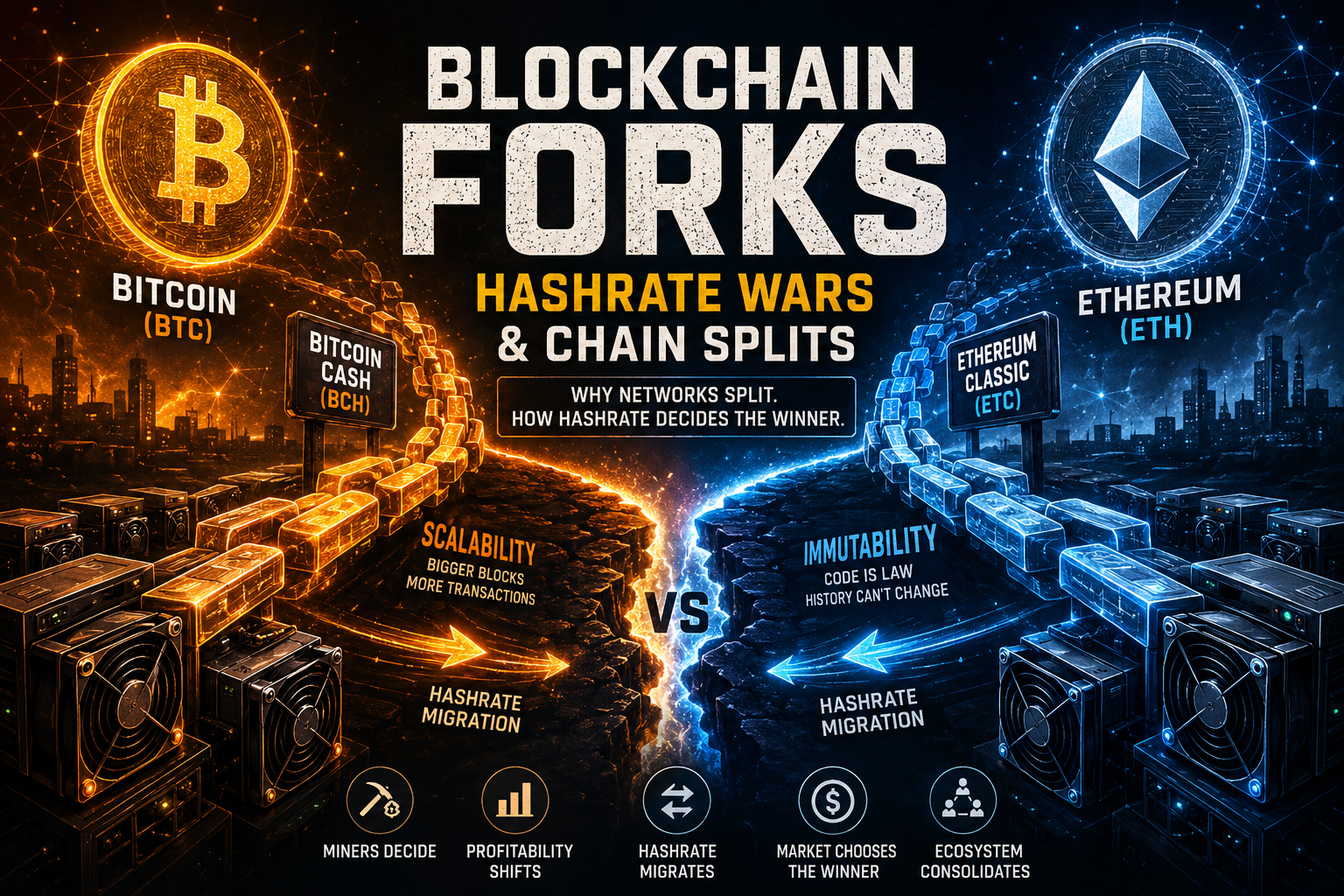
Introduction
In crypto, nothing is truly permanent—not even the rules that define the network itself. One day, there is a single chain, a single vision, and a shared belief in how the system should work. The next day, that reality fractures.
What most people see as new coins—like Bitcoin Cash or Ethereum Classic—are not just alternatives. They are the visible scars of conflict. Behind every fork lies a battle over power, economics, and ideology.
For miners, these moments are not theoretical debates. They are high-stakes decisions where choosing the wrong side can mean mining a dying chain—or missing out on the next dominant network. Profitability shifts. Hashrate migrates. Entire ecosystems realign in a matter of days.
This guide is not about defining forks. It’s about understanding why they happen, how they reshape the market, and how to position yourself when the chain you trust suddenly splits in two.
Understanding Blockchain Forks: Why Decentralized Networks Choose to Split
The Foundation: One Network and a Universal Set of Rules
A blockchain works because thousands of independent participants follow the same rulebook. These rules define:
-
What a valid transaction looks like.
-
How new blocks are created.
-
How the shared history is updated.
As long as everyone agrees on these rules, the network stays synchronized with one version of the truth.
Why Consensus Fails: When Agreement Breaks Down
Blockchains are not static systems; they must evolve to fix issues or improve performance. Since there is no central authority, updates only succeed if enough participants choose to adopt them.
-
Controversial Topics: Disagreements usually stem from governance, decentralization, or economic incentives.
-
The Result: When compromises fail, the network splits into two paths, each continuing with a different interpretation of the rules.
The Key Differences Between Soft Forks and Hard Forks for Crypto Miners
Soft Forks: Upgrading the Network Without Breaking the Chain
A soft fork is a rule change that remains compatible with older versions of the software.
-
Compatibility: Participants who don’t upgrade can still follow the chain and accept new blocks.
-
Miner Impact: Usually means adapting to new rules without facing a sudden choice between two competing chains.
-
Example: Bitcoin’s SegWit upgrade (2017), which optimized transaction data while keeping the network unified.
Hard Forks: When a Blockchain Permanently Splits into Two Networks
A hard fork is more disruptive because the new rules are not compatible with the old ones.
-
Network Split: Participants who don’t upgrade see new blocks as invalid.
-
Critical Decisions: For miners, this is a make-or-break moment where they must choose which chain to support based on rewards and long-term prospects.
Analyzing Famous Blockchain Splits: Real-World Lessons from Ethereum and Bitcoin
Ethereum and Ethereum Classic: The Aftermath of the DAO Crisis
In 2016, a major exploit in "The DAO" project led to a philosophical split:
-
Ethereum (ETH): Chose to alter the blockchain history to return stolen funds to users.
-
Ethereum Classic (ETC): Believed in "immutability" (history should never be changed) and continued the original chain.
-
Mining Lesson: This created two distinct assets and communities, forcing miners to decide which vision to back with their hardware.
Bitcoin and Bitcoin Cash: The Great Scaling Debate
In 2017, a conflict regarding how to handle high transaction volumes led to the creation of Bitcoin Cash (BCH).
-
The Conflict: One group wanted larger blocks for more transactions; the other prioritized keeping participation easy and decentralized.
-
Market Result: Miners had to evaluate two networks with similar origins but vastly different economic priorities.
How Cryptocurrency Forks Directly Affect Mining Profitability
Navigating Two Different Economic Realities
When a hard fork happens, miners must calculate which chain offers better returns. This depends on:
-
Market Price: Higher prices usually attract more hash power.
-
Network Activity: High volume leads to more transaction fees for miners.
-
Long-term Confidence: The project's roadmap and developer support.
- Hashrate Migration: Miners rapidly shift toward the chain with higher short-term profitability.
- Price Divergence: Within days or weeks, one asset often outperforms the other significantly.
- Liquidity Concentration: Exchanges and traders tend to favor one dominant chain, reinforcing its position.
- Network Effect: Developers, users, and applications consolidate around the perceived “winner.”
Why Market Confidence Outperforms Short-Term Hype
Not every fork creates a lasting competitor. Sustainable profitability is usually linked to:
-
Strong community and developer support.
-
Clear use cases and ongoing adoption.
-
Healthy market liquidity and trading interest.
Interpreting Market Trends and Investor Behavior During a Network Split
Forks as Indicators of Deeper Strategic Conflicts
Major forks often reveal the "internal health" of a project. They can:
-
Signal changes in governance and priorities.
-
Unlock innovation by testing two different approaches simultaneously.
-
Occasionally fragment a community and weaken overall confidence.
The Power of Narrative and Public Perception
After a fork, both chains compete on "storytelling." Which one is the "true" continuation?
-
Network Effects: The chain with more users, applications, and attention tends to dominate.
-
Value Driver: Market value and liquidity strongly influence where mining economics stay favorable.
Practical Strategies for Miners to Manage Risks Around a Fork
Evaluating More Than Just the Technical Split
Before shifting your mining strategy, always evaluate:
-
Community momentum and social media sentiment.
-
Exchange support: Will major platforms list the new coin?
-
Real-world adoption signals and merchant interest.
Effective Risk Management in a Volatile Forked Market
-
Avoid Overexposure: Don't put all your resources into an unproven new chain immediately.
-
Watch Liquidity: Monitor how easily the new asset can be traded.
-
Stay Adaptable: Be ready to switch back if the market shows a clear preference for one chain over the other.
The Long-Term Impact of Forks on Real-World Use Cases
Forks are ultimately about how blockchains are used. Some chains focus on fast payments, while others focus on complex applications or preserving original principles. For miners, the long-term value of a chain depends entirely on its ability to solve real problems and maintain the trust of its users.
The Final Verdict: Where the Hashrate Settles
In crypto, a fork is never just a technical event—it’s a moment where belief, incentives, and reality collide.
Every split forces a brutal question: Which chain actually matters? Not in theory, but in adoption, liquidity, and survival. History has shown that the market doesn’t reward ideology alone. It rewards traction. It rewards usage. It rewards the chain that people choose to build on, trade, and trust.
For miners, this isn’t about loyalty—it’s about clarity. The hashrate doesn’t lie. It flows where profitability meets confidence, and it abandons narratives that fail to convert into real demand.
Forks will continue to happen. Conflicts will continue to reshape networks. But in the end, only a few chains earn the right to persist.
The real edge is not predicting forks—it’s understanding where value will consolidate after the split.
FAQ: Top Community Questions from Reddit
Q1. "If a hard fork happens, do I automatically get 'free money' on the new chain?"
The Answer: Not exactly. While you technically own assets on both chains if you hold your private keys at the time of the "snapshot," the value of the new coin depends entirely on market liquidity. If no exchanges list the coin or if there are no buyers, those coins have zero real-world value. Always move your assets to a private wallet before a fork to ensure you can claim the new tokens.
Q2. "Should I immediately switch my hashrate to a new fork to catch 'early miner' rewards?"
The Answer: This is a high-risk strategy. Early mining on a new fork often means lower network difficulty, allowing you to accumulate coins faster. However, you are betting that the coin will maintain value. Professional miners typically keep the majority of their hardware on the stable chain and only allocate a small "speculative" percentage to the new fork until it proves its viability.
Q3. "Can a soft fork 'brick' or damage my older mining hardware or nodes?"
The Answer: No. By definition, a soft fork is backward-compatible. Older software and hardware will still see new blocks as valid. However, you may miss out on new efficiencies (like lower fees or better privacy). While not mandatory for network participation, updating your software is always recommended to maintain peak mining efficiency.
Q4. Why do some forks like Ethereum Classic (ETC) survive while hundreds of others disappear?
The Answer: Survival is driven by the ecosystem, not just the code. A fork survives if it maintains three pillars: Developers to fix bugs, Miners to secure the network, and a Community that provides value. ETC survived because it represented a specific ideology (Code is Law). Most forks fail because they lack a unique use case, leading participants to abandon them once the initial hype fades.