
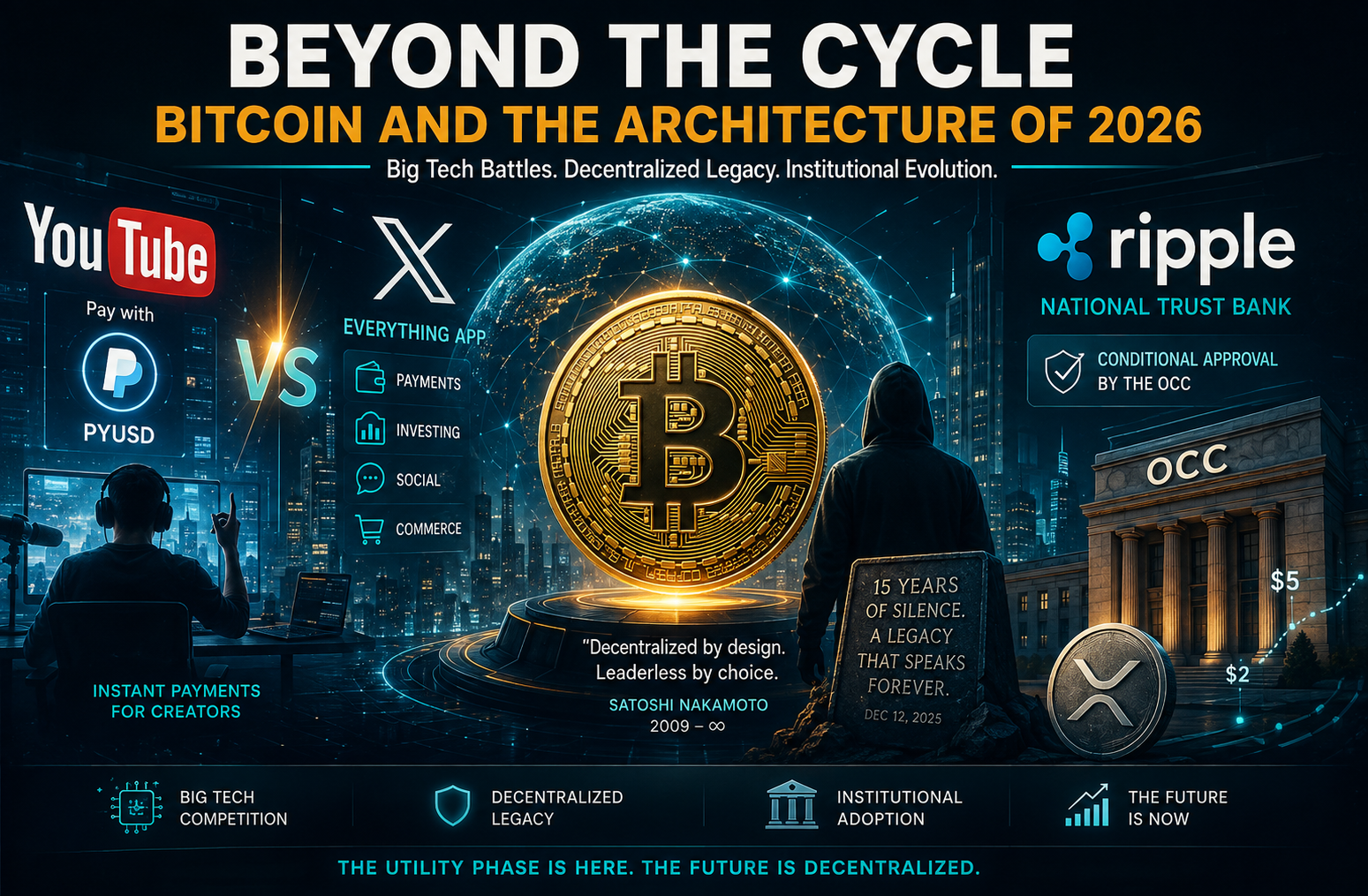
Beyond the Cycle: Bitcoin and the Architecture of 2026
What we are witnessing in 2026 is the final collapse of the wall between traditional finance and decentralized reality. Bitcoin has matured from a speculative asset into a structural necessity. As we analyze the early months of this year, it is clear that we are no longer in a crypto cycle—we are in a systemic upgrade.
The players have changed, and so have the rules. We are seeing a rare convergence where the decentralization of Satoshi meets the centralized might of BlackRock and the disruptive energy of Big Tech. It is a moment of unprecedented tension: a world where money is being rewritten by code, and control is the ultimate prize.
This analysis focuses on the three forces driving this shift: the strategic battle for the payment layer between YouTube and X; the enduring power of Bitcoin’s leaderless design; and the pragmatic evolution of Ripple from defendant to a licensed financial institution. History will remember 2025 for its confidence, but it will remember 2026 for its implementation.
1. The Big Tech Crypto Battle: YouTube, PayPal, and the "Everything App"
A strategic war is unfolding between Silicon Valley’s elite, serving as a massive catalyst for crypto integration into daily life.
- The YouTube Preemptive Strike: In a significant move to defend its market share, YouTube (Google) has partnered with PayPal to integrate the PYUSD stablecoin into its infrastructure. This allows American content creators to receive earnings instantly, bypassing traditional banking delays and high fees.
- The Motivating Factor: This isn't merely a technological upgrade; it is a defensive maneuver against Elon Musk’s X. Musk is aggressively transforming X into an "Everything App" with a built-in financial ecosystem.
- Mass Adoption Implications: By offering "one-button" crypto payments to millions of creators, YouTube is normalizing digital wallets. For investors, this competition drives utility and increases the underlying value of the crypto ecosystem.
2. The Satoshi Nakamoto Mystery: Decentralization Through Absence
December 12, 2025, marked the 15th anniversary of the final message from Bitcoin’s pseudonymous creator, Satoshi Nakamoto.
- The Ultimate Sacrifice: Satoshi disappeared in 2010, leaving behind approximately one million Bitcoins that remain untouched. This disappearance is arguably the most important event in Bitcoin’s history.
- Strengthening the Network:
- No Single Point of Failure: Without a CEO or a central figurehead to subpoena or pressure, Bitcoin remains truly decentralized.
- Digital Gold Status: This lack of a central leader allows Bitcoin to function as an unstoppable financial asset. As it tests historic resistance lines in 2026, the market views it increasingly as a "Digital Gold" that belongs to everyone rather than a corporation.
3. The Reality of Ripple Bank: OCC Approval and Market Truths
Ripple’s journey from the courtroom to the boardroom has reached a new milestone, though market expectations require a dose of realism.
- Conditional Bank Approval: The U.S. Office of the Comptroller of the Currency (OCC) has granted Ripple conditional approval to become a national Trust Bank.
- Note: This is not a final license. Ripple must meet strict compliance and oversight standards before operations begin.
- Debunking the $589 Myth: Despite the "XRP Army’s" historic price targets, XRP currently sits around $2. Two primary factors limit immediate explosive growth:
- Continuous Supply: Ripple continues to sell portions of its holdings to fund ecosystem development.
- Institutional Caution: "Smart Money" is waiting for the transition from "conditional" to "final" licensing before committing billions in liquidity.
- Success Metrics: While a jump to $500 remains unrealistic in the current climate, breaking the $4 or $5 resistance would signify a monumental success for the project.
Final Analysis: Building the Future on the Architecture of Trust
As we look at the landscape of 2026, it is clear that we have entered the "Utility Phase" of the digital asset revolution. The "Big Tech Crypto Wars" between YouTube and X are more than just a struggle for market share; they represent the final surrender of traditional payment rails to the efficiency of the blockchain. At the same time, Ripple’s journey toward becoming a licensed bank proves that even the most scrutinized projects can find a seat at the table through persistence and compliance.
However, amidst this corporate and institutional rush, the silent legacy of Satoshi Nakamoto remains the industry’s most powerful anchor. The fact that Bitcoin stands leaderless in a world of warring CEOs and shifting regulations is precisely what cements its role as Digital Gold. We are standing at the edge of a new financial era where the million-dollar milestone for Bitcoin feels less like a speculative target and more like an inevitable adjustment to a world that has finally embraced digital scarcity. The bridge is built, the institutions have crossed, and the path toward a decentralized future is now the only road ahead.
Frequently Asked Questions: Bitcoin & The Future of Crypto 2026
Q1: Is Bitcoin truly the "Digital Gold" of 2026?
Answer: Increasingly, yes. With institutional giants like BlackRock treating it as a long-term reserve asset and the U.S. establishing clear regulatory frameworks, Bitcoin has moved past pure speculation. Its fixed supply and decentralized nature make it a primary hedge against traditional currency inflation, cementing its status as the digital era's version of gold.
Q2: Why are YouTube and Elon Musk’s X fighting over crypto integration?
Answer: It’s a battle for the future of the "Creator Economy." YouTube is integrating stablecoins like PYUSD to offer instant, borderless payments to creators, aiming to retain talent before Elon Musk’s X fully launches its financial ecosystem. For users, this "Big Tech Crypto War" means faster payments, lower fees, and the mass adoption of digital wallets in everyday life.
Q3: What does Ripple’s "Conditional Bank Approval" actually mean for XRP?
Answer: It is a major milestone, but not a final victory. The OCC's conditional approval means Ripple has a clear roadmap to becoming a national trust bank, provided they meet strict compliance and oversight standards. This "wait-and-see" period is why the price hasn't hit legendary targets like $589; institutional "Smart Money" is waiting for the final license before fully committing.
Q4: Does Satoshi Nakamoto’s 15-year disappearance still matter for Bitcoin?
Answer: Absolutely. Satoshi’s disappearance is Bitcoin’s greatest strength. By removing a central leader, Bitcoin became truly decentralized—there is no CEO to arrest and no single entity to control the network. This 15-year silence proves that Bitcoin is a leaderless, global public utility, which is essential for its long-term trust and survival.