
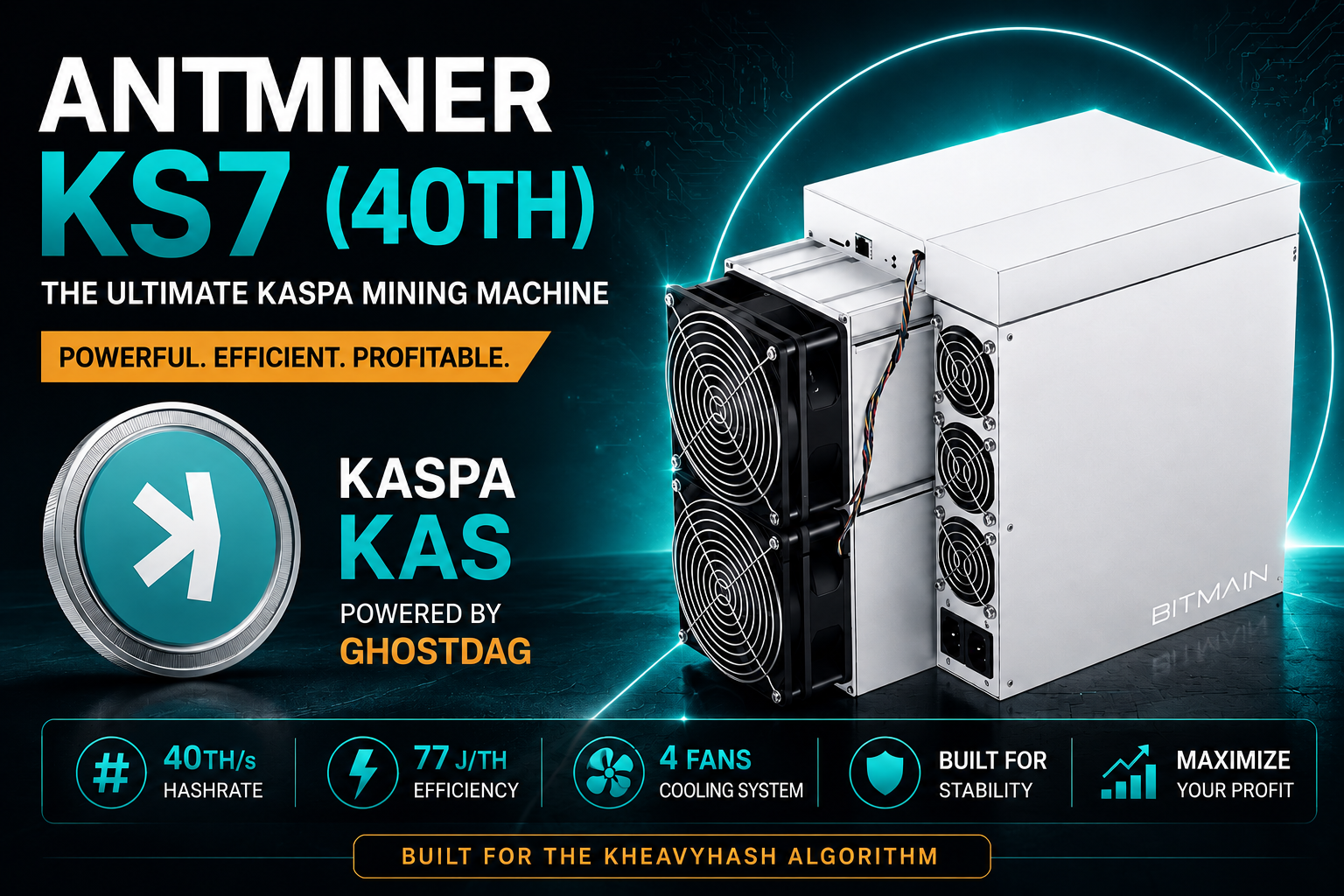
Kaspa Mining Explained: GHOSTDAG, PoW, and the Shift from GPUs to ASICs
Kaspa (KAS) is becoming a very strong contender as a Proof-of-Work (PoW) network in the cryptocurrency space. Kaspa shifts our perspective on blockchain technology, thanks to the GHOSTDAG protocol. This system allows for parallel block existence and offers instant transaction confirmation. This approach scales better than earlier blockchain options.
In its early stages, Kaspa was primarily mined using Graphics Processing Units (GPUs). However, as the network difficulty surged, the industry transitioned into the ASIC era. Today, specialized hardware like the Antminer KS7 provides a level of efficiency and computational power that makes GPU mining for Kaspa obsolete.
The KHeavyHash Algorithm and Ecosystem
The Antminer KS7 was designed specifically for the KHeavyHash algorithm. This algorithm was created specifically to be energy-efficient while keeping a high level of security. It's worth noting that while Kaspa is the main focus, the KHeavyHash ecosystem also includes several other projects and forks.
- Kaspa (KAS): The flagship asset and most liquid coin in the sector.
- Bugna (BGA): An emerging project focused on decentralized gaming and sub-networks.
- Sedra (SEDRA): An innovative ecosystem expanding the utility of the KHeavyHash protocol.
Economic Analysis: Profitability and ROI
The Antminer KS7 (40Th) represents the pinnacle of mining efficiency for 2026. Below is a breakdown of the earning potential based on current market dynamics:
1. Gross Profit (Zero Electricity Cost) is a practical measure for understanding financial performance when electricity expenses are not a factor in your calculations. Without accounting for power expenses, the KS7 is estimated to generate about $10 daily. This will cost you $300 per month. Savvy investors often look for rapid returns, and this machine offers an impressive high gross yield, ensuring a quick payback period.
2. Net Profit (at $0.08/kWh Reference Rate)
For users in regions where the standard industrial electricity rate is $0.08 per kWh, the calculation is adjusted to account for the 3080W power consumption:
-
Daily Electricity Cost: approx. $5.91
-
Daily Net Profit: approx. $4.09 – $5.00
Technical Note: Profitability is subject to "Network Difficulty" adjustments and the market price volatility of KAS. However, the KS7's 40Th output provides a significant buffer against difficulty increases compared to older 8Th or 10Th models.
Antminer KS7 | Official Technical Specifications
Executive Summary: The Antminer KS7 is currently the "King of KAS." With a net profit of around $5/day even at $0.08/kWh, it offers a sustainable mining operation that outclasses the competition in terms of build quality and long-term resale value.
Executive Summary: The Antminer KS7 is currently the "King of KAS." With a net profit of around $5/day even at $0.08/kWh, it offers a sustainable mining operation that outclasses the competition in terms of build quality and long-term resale value.
Antminer KS7 (40Th) Technical Table
| Category | Parameter | Technical Intelligence & Comparative Notes |
|---|---|---|
| Manufacturer | Bitmain | Industry leader in ASIC production and global maintenance networks. |
| Model Name | Antminer KS7 | 2025 Flagship KHeavyHash hardware for professional operations. |
| Algorithm | KHeavyHash | Specifically optimized for high-efficiency Kaspa network security. |
| Cryptocurrency | KAS (Kaspa) | The most profitable PoW asset in the current specialized ASIC sector. |
| Hashrate | 40 TH/s | Top-tier throughput; currently the most powerful single unit for KAS. |
| Release Date | May 2025 | Latest generation hardware ensuring long-term mining competitiveness. |
| Cooling System | 4 Fans | Quad-fan high-velocity push-pull configuration for thermal stability. |
| Efficiency Ratio | 77 J/TH | Excellent power-to-hash ratio maximizing net daily margins. |
| Power Consumption | 3080W ±5% | Heavy-duty power draw requiring stable industrial-grade electrical supply. |
| Input Voltage | 220V - 277V | Wide AC range; supports global industrial 240V/277V power grids. |
| Frequency Range | 50 / 60 Hz | Universal frequency support for worldwide data center integration. |
| Power Interface | C19 / C20 | Standard high-current industrial connectors for safe operation. |
| Network Mode | RJ45 Ethernet | 10/100M Connectivity; essential for low-latency pool communication. |
| Product Size (Net) | 430×195×290 mm | Optimized for horizontal and vertical stacking in professional racks. |
| Package Size (Gross) | 570×316×430 mm | Standardized logistics dimensions for protected global air freight. |
| Net Weight | 16.4 KG | Solid aluminum chassis design for enhanced passive heat dissipation. |
| Gross Weight | 18.0 KG | Includes multi-layer foam protection for overseas shipping safety. |
| Noise Level | 75 dBA | Standard industrial noise profile; designed for specialized mining sites. |
| Operating Temp | -20 ~ 45 °C | Versatile operational range; performs optimally in climate-controlled sites. |
| Operating Humidity | 10% ~ 90% RH | Moisture-resistant PCB coating prevents corrosion in humid climates. |
| Storage Temp | -40 ~ 70 °C | High tolerance for non-operational environments during transport. |
| Warranty | 180 Days | Official Bitmain manufacturer warranty covering all major components. |
| Estimated ROI | ~4.27 Months | Fastest payback period in the 2026 market (based on $0.05/kWh). |
| Market Valuation | $1,435 - $1,620 | Competitive pricing for a 40TH unit; subject to KAS price volatility. |
Final Verdict: Is the Antminer KS7 Worth It in 2026?
The Antminer KS7 (40Th) is shaping up to be one of the strongest choices for Kaspa mining in 2026. What really sets this rig apart is its efficiency and long-term reliability. Even as network difficulty continues to rise, the KS7 manages to stay profitable under reasonable electricity costs making it a solid and dependable asset for serious miners.
Its advantage isn’t limited to short-term speculation. The KS7 benefits directly from Kaspa’s GHOSTDAG architecture and the continued expansion of the KHeavyHash ecosystem which gives it a more strategic, future-proof position.
Unlike older generations, the KS7 was clearly designed for longevity. This translates into predictable operation, stable hash power, and stronger resale value over time.
For miners operating with electricity costs below $0.08/kWh, the KS7 offers a clear strategic edge. It’s particularly well-suited for professional mining farms, data centers, and investors who want exposure to Kaspa’s growth without constantly worrying about hardware upgrades.
In the end, the Antminer KS7 (40Th/s) really is a cornerstone for the Kaspa ecosystem. It's a foundational piece of infrastructure that plays a crucial role.
Frequently Asked Questions (FAQ)
Q1: Is it too late to start mining Kaspa with the KS7 in 2026?
The Reality Check: Honestly? It’s never too late, but the gold rush phase has evolved. While the early days of GPU mining are long gone, the Antminer KS7 is built specifically for this mature stage of the network. It’s no longer about getting lucky; it’s about efficiency. With its 40Th output, you’re positioned to stay profitable even as network difficulty climbs, provided you have access to reasonable electricity rates.
Q2: Can I run the Antminer KS7 at home, or is it too loud?
The Truth: Unless you have a soundproof garage or a dedicated outbuilding, we wouldn't recommend it. At 75 dBA, it sounds like an industrial vacuum cleaner that never turns off. Beyond the noise, it generates massive amounts of heat (3080W worth!). This is professional-grade hardware meant for a ventilated space or a mining farm, not your living room or office.
Q3: Why buy a KS7 instead of just buying KAS coins directly?
The Strategy: It’s the classic "buy the fish vs. buy the net" debate. Buying KAS on an exchange is faster, but mining with a KS7 gives you a daily stream of coins regardless of market swings. In the long run, if Kaspa stays strong, the machine often pays for itself and continues to produce "cheaper" coins compared to the market price. It’s a long-term play for those who want a steady accumulation strategy.
Q4: How long will the KS7 stay "relevant" before a new model replaces it?
The Longevity: In the ASIC world, hardware cycles move fast, but the KS7 has a serious edge. Its efficiency ratio (77 J/TH) is top-tier for 2026. Even if a "KS8" or a newer model hits the market, the KS7 is efficient enough to remain profitable for several years before its margins get squeezed. It’s designed to be a marathon runner, not just a sprinter.