
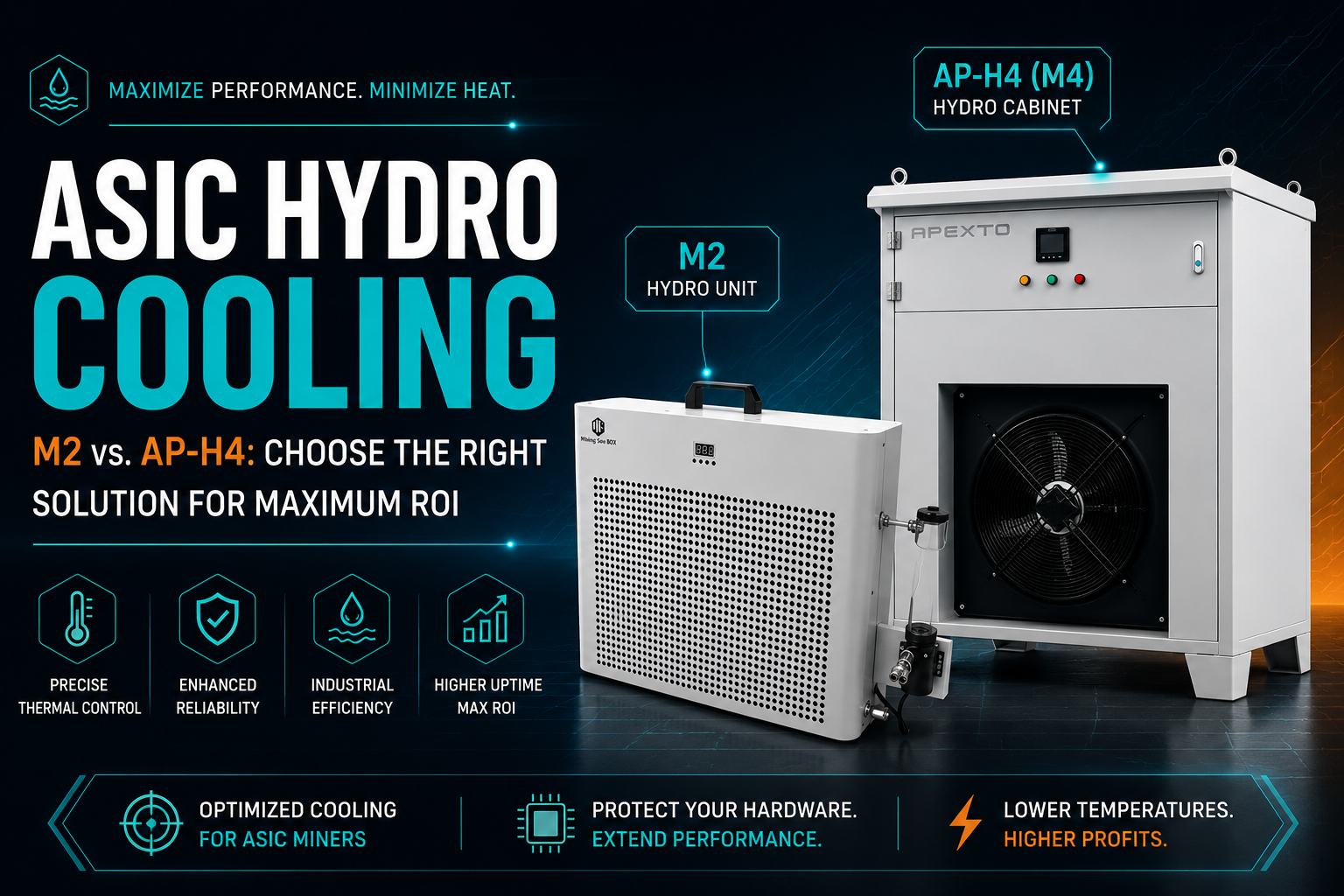
Introduction
In the current epoch of mining, we have moved past the era of brute-force air cooling. As we integrate 3nm and 2nm chip architectures into our fleets, the heat density per square millimeter has reached a tipping point. Managing this is no longer about fan speed; it is about heat transfer coefficients. The M2 and AP-H4 represent the hardware layer required to transition from amateur setups to optimized, high-uptime mining operations.
M2 Hydro Cooling Platform Review: Precision Thermal Management Solutions for Distributed Hashpower
The M2 Hydro Cooling Unit serves as the primary gateway for miners transitioning away from air-cooled environments. It is a closed-loop system that prioritizes thermal stability for up to two hydro-compatible ASICs.
Best Practices for Operational Intelligence and Thermal Safeguards in Hydro Systems
The M2’s 12 kW dissipation capacity is specifically tuned for the thermal envelope of the latest Antminer Hydro series. Its 4500 RPM fan system is governed by an automated logic controller that synchronizes with the miner’s internal temperature sensors via the control board. While the technical sheet lists a 32°C (90°F) threshold, practitioners in 2026 understand that thermal saturation is the real enemy. In high-humidity regions, the M2’s efficiency drops. I advise operators to monitor the Delta-T (Δ T) between the inlet and outlet water temperatures; if this exceeds 15°C, the workload must be reduced to a single unit to maintain chip longevity.
Analyzing Energy Efficiency and Achieving Low Power Overhead for Home Mining
With a power draw of only 130–200W, the M2 is an incredibly lean system, ensuring that your Power Usage Effectiveness (PUE) remains as close to 1.0 as possible. This makes it a preferred choice for residential or office-based mining setups where energy overhead must be kept to a minimum.
AP-H4 (M4) Cabinet Technical Breakdown: Industrial-Grade Hydro Cooling for Scalable Mining Farms
For those managing a Mini-Farm or a residential-industrial hybrid, the AP-H4 (or M4) is the indispensable choice. It is not merely a radiator; it is a Centralized Thermal Management System (CTMS).
Industrial Build Quality and High-Capacity Heat Rejection for Professional Miners
Built from high-grade stainless steel and utilizing EPDM (Ethylene Propylene Diene Monomer) hoses, the AP-H4 is resistant to the chemical degradation often seen in cheaper PVC-based systems. This is vital when using modern corrosion inhibitors and glycol-based coolants. The 26 kW capacity allows for the simultaneous cooling of four flagship miners. In the US market, where the Antminer S21/S23 Hydro units are becoming the backbone of decentralized mining, the AP-H4 provides the necessary 2 m³/h flow rate to ensure no single unit in the series suffers from heat soak.
Professional Power and Infrastructure Requirements for 3-Phase Mining Cabinets
The AP-H4’s 3-Phase 380V requirement is a professional barrier. In 2026, we see more miners utilizing custom transformers to step up 240V residential lines, but for maximum efficiency, a direct industrial drop is recommended to handle the cabinet’s power load alongside the miners' heavy draw.
Essential Hydro Cooling Maintenance in 2026: Pro Tips for Operator Best Practices
Transitioning to hydro requires a shift in the maintenance mindset. In 2026, we utilize a rigorous approach to system health focusing on fluid chemistry and hydraulic pressure.
Critical Coolant Chemistry: Managing Conductivity, Ion Buildup, and pH Control
Monitoring Coolant Conductivity is the most critical task. If conductivity exceeds 100 μS/cm, it indicates that ions are building up in the fluid, which can lead to electrical leakage or corrosion. In such cases, the system must be flushed and replaced with fresh deionized water. Similarly, the pH Level must be maintained between 7.5 and 9.5. Falling outside this range invites acidic or alkaline corrosion, which can pinhole the delicate copper water plates inside your ASICs.
Preventing Localized Chip Failure through Flow Pressure Management and Safety Protocols
Operators must ensure that Flow Pressure stays below 0.3 MPa. High pressure is often a symptom of blockages in the hashboard manifolds—usually caused by "sludging" if incompatible coolants were mixed. Never mix different brands of coolants, as chemical additives can react and coat the internal micro-channels, leading to localized chip failure even if the overall water temperature appears normal.
M2 vs. AP-H4 Comparison: Technical Specifications and Hashrate Capacity Analysis
| Technical Feature | M2 Hydro Unit | AP-H4 (M4) Cabinet |
|---|---|---|
| Target Market | Home/Small Scale | Professional/Farm |
| ASIC Capacity | Up to 2 Units | Up to 4 Units |
| Heat Dissipation | 12 kW | 26 kW |
| Device Weight (Net) | 22 kg | ~105 kg (Cabinet System) |
| Fluid Flow Rate | Standard Loop | 2.0 m³/h |
| Ambient Operating Temp | Up to 32°C (Optimal) | -25°C to 45°C |
| Noise Level | 30 – 70 dB | Industrial Low-Noise |
| Power Input | 110V - 240V | 3-Phase 380V (50/60Hz) |
| Dimensions | 56 × 45 × 15.1 cm | 80 x 70 x 120 cm (approx.) |
| Market Price (Est.) | $300 | $1,450 |
Whether you are looking for a quiet home setup or building the next industrial-scale farm, the data in the table above makes one thing clear: thermal management is the key to mining longevity.
Final Performance Analysis: Choosing Between M2 and AP-H4 Infrastructure
Analysis of the Data:
- The M2 Advantage: This unit is ideal for decentralized residential miners. Its ability to run on standard voltage and its compact 22 kg frame make it the most versatile "plug-and-play" hydro solution on the market.
- The AP-H4 Advantage: This is a ruggedized, all-weather solution. The 26 kW capacity is designed to handle the 2026 generation of high-wattage miners (like the S23 series) which often exceed the dissipation limits of smaller radiators during summer months.
Conclusion: Selecting the Right Hydro Cooling Infrastructure for a 2026 Mining Strategy
The M2 is the surgeon’s tool—precise, quiet, and perfect for small-scale deployments (Approx. $300). The AP-H4 is the heavy-duty engine—powerful, scalable, and designed for the rigors of 24/7 industrial mining (Approx. $1,450). As we look toward the remainder of 2026, the competitive edge belongs to those who control their heat. Investing in hydro cooling is no longer an "upgrade"—it is the baseline for professional mining.
Note: This article is purely informational and is not intended as promotional or advertising content. Its purpose is to provide detailed technical and operational information about the M2 and AP-H4 hydro cooling units for cryptocurrency mining.