Introduction: Mining vs. Staking — Why the "Smart Money" Isn’t Choosing One
In the 2026 crypto landscape, the most expensive mistake an investor can make isn’t picking the wrong asset—it’s relying on a single, linear strategy in a market that rewards diversification.
We see it every cycle: some miners chase the dream of "printing" Bitcoin daily, obsessed with hashrate and hardware. Meanwhile, others lean entirely into staking, seduced by the promise of passive yield with zero physical footprint. But here is the truth that the most successful practitioners have already figured out:
The real edge in 2026 doesn't come from choosing between mining and staking—it comes from fusing them into a single, resilient engine.
Mining is industrial. It’s raw power, energy infrastructure, and direct exposure to the fundamental scarcity of Proof-of-Work. It’s the "steel and silicon" foundation of the digital economy.
Staking is financial. It’s liquidity, compounded yield, and consistent rewards across the Proof-of-Stake ecosystem. It’s the "dividend and governance" layer of the new financial stack.
When you treat these as separate silos, you leave money on the table. When you combine them, they stop being isolated bets and start becoming a portfolio that performs in every market condition.
In this guide, we’re stripping away the tribalism. We’ll break down exactly where each strategy wins, where they fail, and how elite investors are balancing "the rig" and "the node" to build multi-layered wealth that survives the volatility of 2026.
Crypto Mining Explained: Understanding Proof of Work Infrastructure
To understand mining is to understand the very infrastructure that hides behind Bitcoin, a system built on what we call Proof of Work where ultra-powerful machines known as ASICs resolve complex calculations to secure the network in exchange for freshly minted bitcoins. A major element to keep in mind is the "halving," which occurs every four years and divides the mining reward by two; this reduction in supply is a fundamental mechanism that has historically triggered great bullish cycles, making the act of mining not just a technical endeavor but a strategic long-term investment.
Bitcoin Halving and Its Impact on Mining Profitability
While many point fingers at the energy consumption of this sector, the reality is shifting toward a circular energy economy where actors increasingly utilize 100% renewable sources like hydro, solar, and geothermal, or even "flared gas," while simultaneously repurposing the heat generated by these machines to warm greenhouses and buildings.
For those who seek a turnkey solution without the technical headaches of managing hardware or electricity, services like Feel Mining handle the entire process from the moment a machine is ordered to its operation in specialized sites like the Emirates or Mexico, providing monthly production reports and direct Bitcoin deposits so you can watch your assets grow with total transparency.
Crypto Staking Explained: Passive Income Through Proof of Stake
Staking: The Software Engine for Passive Rewards and Network Security
On the other side of the spectrum, we find staking, which serves as the engine for blockchains using Proof of Stake—such as Ethereum, Solana, or Cardano—and offers a way to secure the network without the need for physical machinery or heavy industrial setups. By locking your tokens, you earn interest in a way that is much more accessible to the general public, as you don't necessarily need to hold 32 Ethereum to validate a node on your own when you can group your assets via specialized platforms to lower the barrier to entry.
Risks and Benefits of Staking Cryptocurrencies
While the carbon footprint of staking is virtually zero, the primary imperative remains the commitment to keep your tokens locked during the staking period, which means you stay exposed to market volatility while waiting for those regular rewards. This approach is characterized by its fluidity and simplicity, providing a steady stream of income that contrasts beautifully with the more technical and industrial nature of mining, allowing for a balanced exposure to the digital asset market.
Crypto Mining vs Staking: Key Differences, Profitability, and Risk Comparison
To clearly understand how crypto mining and staking differ in real-world performance, here’s a direct comparison across the most important factors in 2026:
| Factor | Crypto Mining | Crypto Staking |
|---|---|---|
| Capital Required | High (ASIC hardware, setup, infrastructure) | Low to Medium (token-based entry) |
| Profit Model | Variable (depends on BTC price & network difficulty) | Predictable (fixed APY-based rewards) |
| Energy Consumption | High (continuous power usage) | Very Low (no heavy computation required) |
| Risk Level | Medium–High (electricity costs, hardware depreciation) | Medium (token volatility, lock-up periods) |
| Liquidity | Low (capital locked in hardware) | Medium (depends on staking lock duration) |
| Technical Complexity | High (setup, cooling, maintenance) | Low (platform-based or delegated staking) |
| Scalability | High (can expand to industrial-scale operations) | Limited (depends on capital size) |
| Maintenance | High (hardware, uptime, thermal management) | Low (mostly automated systems) |
👉 Mining offers higher long-term upside potential but requires infrastructure and operational management, while staking provides easier access and more predictable passive income with lower complexity.
Mining and Staking Together: A Smart Strategy for Crypto Portfolio Diversification
A Synergistic Approach to Long-Term Wealth Diversification
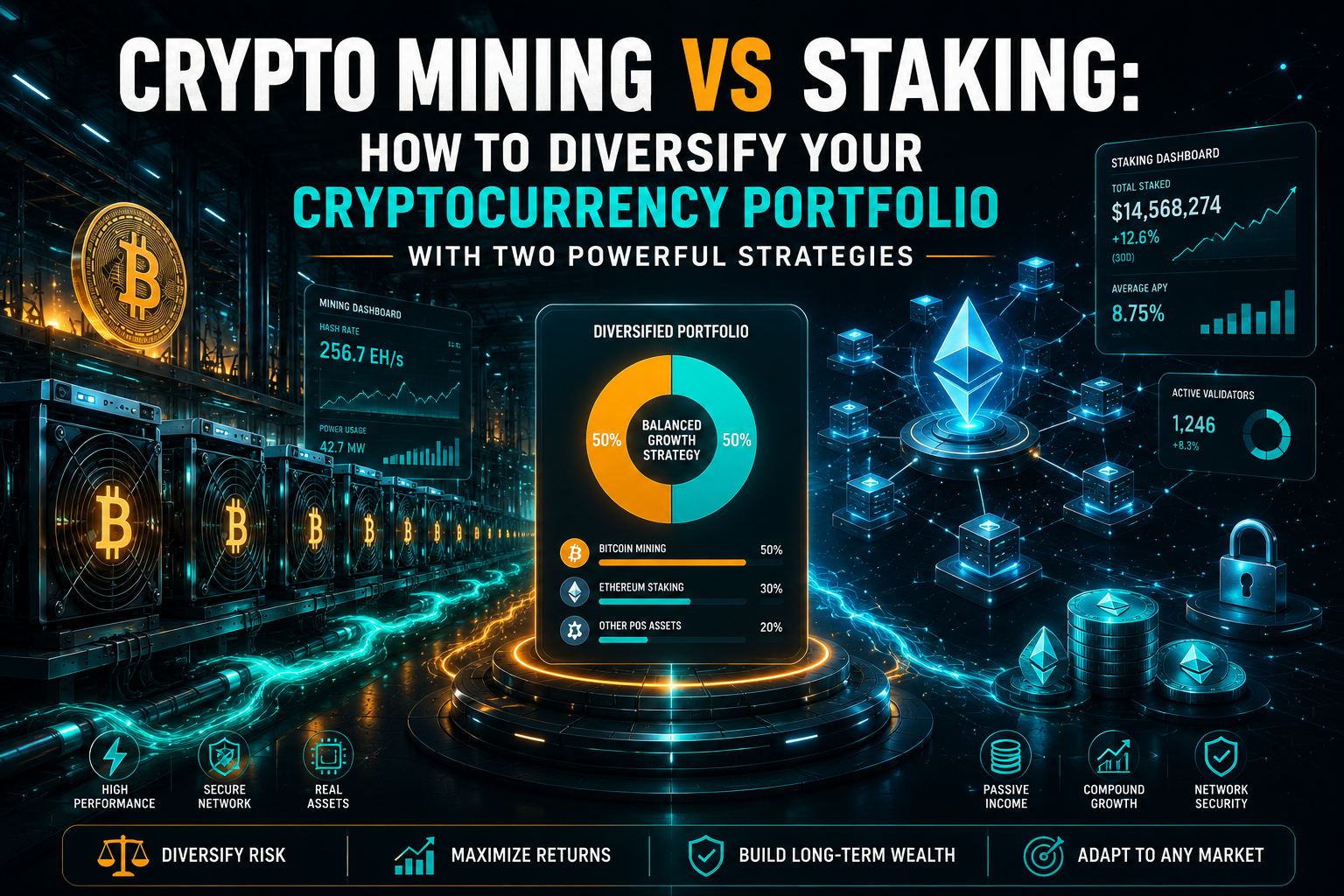
When we look at these two pillars, it becomes clear that they do not oppose each other but rather complete one another perfectly; staking brings an accessible and regular yield, while mining offers a strong, strategic exposure to Bitcoin, especially within the post-halving cycles we have come to expect.
Diversifying a crypto portfolio today means understanding these two different yet highly compatible mechanics, and as I will develop further in my September column for RevueBank, leveraging both allows an investor to build a resilient position that benefits from both the hardware-backed security of Bitcoin and the yield-generating potential of the broader altcoin ecosystem.
Beyond the Basics: Leveraging LSTs and MEV for High-Performance Crypto Portfolios in 2026
The "smart money" in 2026 isn't just locking tokens and waiting. They’re using Liquid Staking (LSTs) to keep their capital moving. Instead of freezing your ETH, LSTs give you a "receipt-token" that earns rewards while you use it as collateral elsewhere. It’s yield without the handcuffs.
The real "alpha" for both miners and stakers now comes from MEV (Maximal Extractable Value). By picking the right pools or validators that optimize transaction ordering, you can squeeze an extra 2–4% APY out of the same setup. It's the difference between a hobbyist and a pro.
But remember: Mining is a race against hardware depreciation, and Staking carries slashing risks if your validator goes offline. The winners aren't just those who know how to start—they’re the ones who know how to protect their stack when the market turns red.
Conclusion: Mining for Assets, Staking for Cash Flow
By 2026, the era of "moonshot" chasing is dead. Survival now belongs to the operators who build systems capable of eating volatility for breakfast.
Mining and staking are not rivals. They are two distinct gears in the same machine.
Mining is your industrial anchor. It gives you direct exposure to "hard" assets like Bitcoin—value backed by raw energy, physical infrastructure, and unchangeable supply math. It’s about building a long-term balance sheet.
Staking is your financial engine. It turns your liquid capital into a yield-generating powerhouse across networks like Ethereum. It offers the flexibility and consistent rewards that keep your cash flow moving while the market breathes.
One accumulates the world’s hardest money. The other compounds your existing wealth.
When you fuse them, you stop being a speculator and start being an architect. You create a portfolio that produces, earns, and adapts simultaneously. But let’s be real—neither is a "set and forget" strategy.
-
Mining lives and dies by power costs, hardware cycles, and thermal efficiency.
-
Staking is tethered to validator uptime, lock-up periods, and protocol-level stability.
The professional edge in 2026 isn't about picking a "winner." It’s about mastering the mechanics of both and positioning yourself to win whether the charts are screaming green or bleeding red.
In this industry, your strategy is your only real moat. The winners aren't those chasing a single profit spike—they’re the ones building the systems that never stop generating them.
👉 The smartest portfolios in 2026 aren’t built on a single strategy—they’re engineered through diversification, discipline, and adaptability.
FAQ: Crypto Mining vs Staking
Q1: What is the difference between crypto mining and staking?
Crypto mining and staking are two different methods of earning cryptocurrency while helping secure blockchain networks. Mining uses specialized hardware (ASICs or GPUs) to solve cryptographic puzzles in Proof of Work systems like Bitcoin. Staking involves locking cryptocurrency tokens in Proof of Stake networks such as Ethereum or Solana to help validate transactions and earn rewards.
Q2: Is mining or staking more profitable in the long term?
Profitability depends on several factors including electricity costs, hardware efficiency, token prices, and network difficulty. Mining can generate higher long-term returns during strong Bitcoin cycles, especially after halvings. Staking typically provides more predictable passive income through regular rewards, making it attractive for investors seeking steady yield.
Q3: Can you combine mining and staking in a crypto investment strategy?
Yes, combining mining and staking is a common diversification strategy in the crypto ecosystem. Mining provides exposure to Bitcoin and hardware-based production of new coins, while staking offers passive income from Proof of Stake networks. Using both strategies can balance risk and create multiple revenue streams.
Q4: What are the risks of cryptocurrency staking?
The main risks of staking include market volatility, lock-up periods where tokens cannot be withdrawn, validator penalties (slashing), and platform security risks. Although staking requires less technical infrastructure than mining, investors must still choose reliable platforms or validators to reduce operational risk.
Q5: Does crypto mining still make sense after Bitcoin halving events?
Yes. Bitcoin halvings reduce the block reward, but historically they have also contributed to long-term price increases due to supply reduction. Efficient miners with access to cheap electricity and modern ASIC hardware can remain profitable, especially when market prices rise after halving cycles.
Q6: Is staking more environmentally friendly than mining?
Generally yes. Staking consumes significantly less energy because it does not require computational competition like Proof of Work mining. Proof of Stake networks rely on token ownership and validator nodes rather than energy-intensive calculations, making staking a lower-carbon alternative for securing blockchain networks.