
Introduction
Singapore is that model country for digital development in Southeast Asia, attracting dozens of data centers for tech giants—chief among them Google, Microsoft, Amazon Web Services, Equinix, and Digital Realty.
For anyone unfamiliar with its geography, it shares a border with Malaysia separated by the Johor Strait, while facing Indonesia to the south across the Singapore Strait, sitting right near the entrance of the Strait of Malacca. This strategic strait will carry immense importance in the future, in a world where maritime passages fully control resources and supply chains—something that could impact Singapore either positively or negatively.
Singapore’s total population stands at 6.111 million, with citizens holding nationality not exceeding 3.661 million, while permanent residents sit at just over half a million. The remaining 1.906 million are foreign workers, students, work visa holders, and others, bringing the proportion of local citizens to around 59.9%. Ethnically, it's a mix with a large Chinese majority exceeding 74%, followed by Malays at 13%, Indians at 9%, and other ethnicities making up the rest.
Despite covering barely 783 square kilometers—roughly equivalent to Hamburg, Germany—Singapore takes third place worldwide on the Network Readiness Index. Scoring an impressive 75.46, it trails only the United States and Finland by a small margin. This index evaluates how effectively a country leverages digital technology across its infrastructure, adoption by citizens and businesses, and digital governance—all with a clear goal: measuring how ready a nation is to build a real digital economy.
Today, living in 2026 and standing on the threshold of 2027, the digital economy has become the main engine of the global economy amid the cryptocurrency revolution, the expansion of cloud computing, crypto mining and validation, alongside accelerating innovations. Yet, this surge faces a genuine challenge: the massive growth in electricity demand. Many view the strength of any digital index as deeply tied to a nation's power infrastructure and its ability to keep costs down. The lower the energy bills, the greater the capacity to draw massive investments into digital infrastructure—specifically AI and cloud computing data centers—which lowers service costs and, in turn, drives the digital index even higher.
Today, electricity costs have turned into a heavy burden due to high energy prices, where any supply chain disruption deeply impacts costs—especially for a country relying on imported fossil fuels for power generation. Meanwhile, issues surrounding maritime bottlenecks and straits, as we've seen throughout 2026, are factors that could shake digital stability in the future. From here comes the focus of our article, shedding light on Singapore’s electricity infrastructure: its future, its capability to keep up with this growth while offering competitive rates, and whether it will remain the top destination for global and regional data center investments.
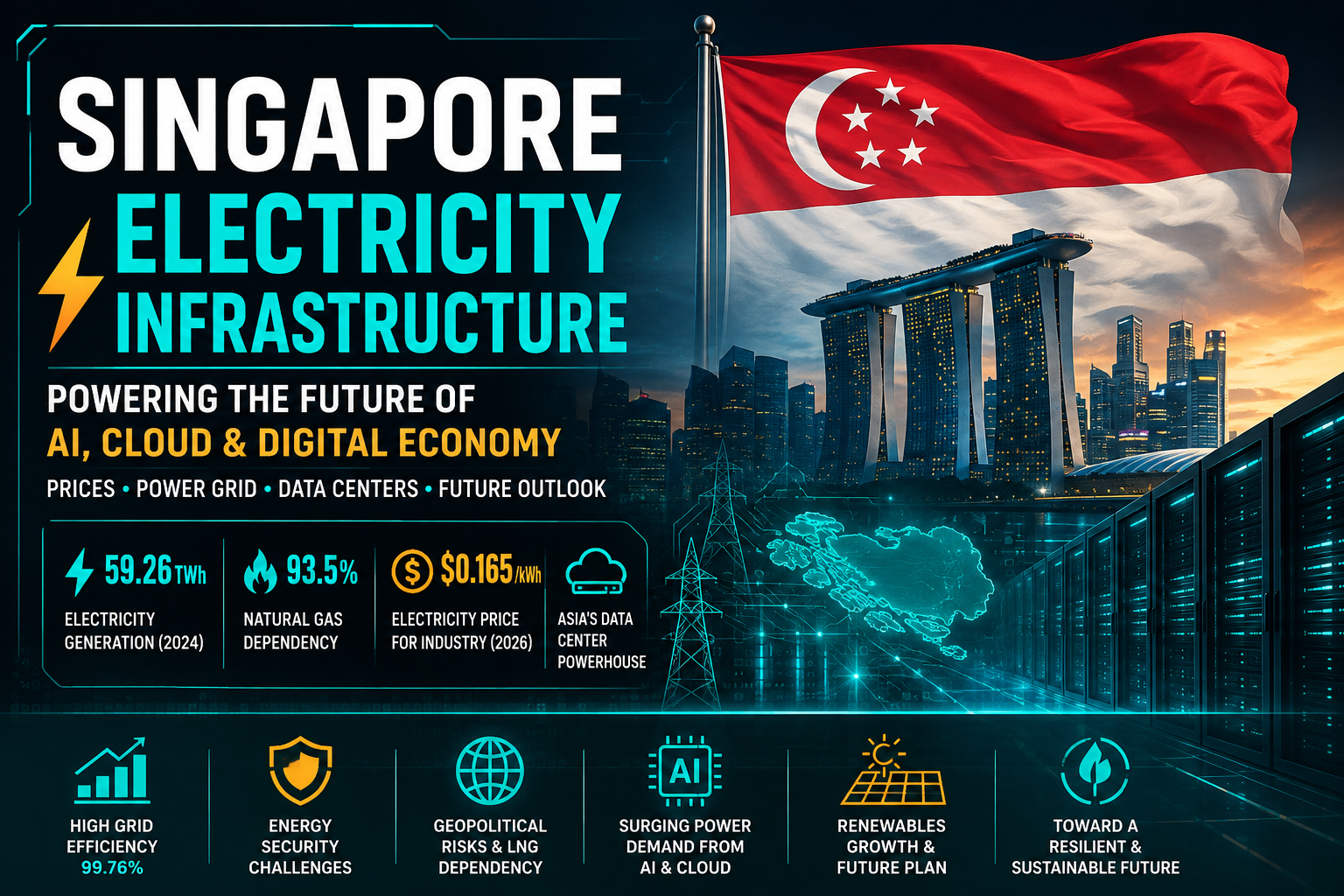
Data from several reliable sources indicates that Singapore’s total electricity generation reached 59.26 TWh in 2024, while consumption stood at approximately 59.12 TWh. This points to a high grid efficiency resulting from a minor loss of just 0.14 TWh, representing an efficiency rate of 99.76%. As a result, Singapore ranks 49th globally in electricity production, despite its small population.
Singapore’s energy infrastructure relies on eight main power generation plants—the largest being operated by Senoko Energy, with an installed capacity of approximately 2,807 MW. All of these plants run on imported natural gas, which holds the lion’s share at 93.5%. The remaining share comes from a variety of sources, including biomass and waste-to-energy at 3%, solar power at 2.2%, coal at 0.89%, and finally oil at 0.3%.
Singapore’s Electricity Generation Mix by Fuel Source (2024)
| Fuel / Energy Source | Percentage (%) | Equivalent (TWh) |
|---|---|---|
| Natural Gas | 93.5% | 55.42 |
| Solar Power | 2.2% | 1.3 |
| Biomass and Waste | 3% | 1.8 |
| Coal | 0.89% | 0.53 |
| Oil | 0.3% | 0.18 |
Singapore Power Stations by Installed Capacity (MW)
| Rank | Power Station | Operating Company | Installed Capacity (MW) |
|---|---|---|---|
| 1 | Senoko Power Station | Senoko Energy | 2,807 |
| 2 | Pulau Seraya Power Station | YTL PowerSeraya | 2,800 |
| 3 | Tuas Power Station | Tuas Power Generation | 2,670 |
| 4 | Keppel Merlimau Cogen | Keppel Infrastructure | 1,300 |
| 5 | Sembcorp Cogen | Sembcorp Industries | 1,190 |
| 6 | PacificLight Power Plant | PacificLight Power | 830 |
| 7 | Taser Power Plant | Taser Power | 120 |
| 8 | TP Utilities Cogeneration Plant | TP Utilities | 100–120 |
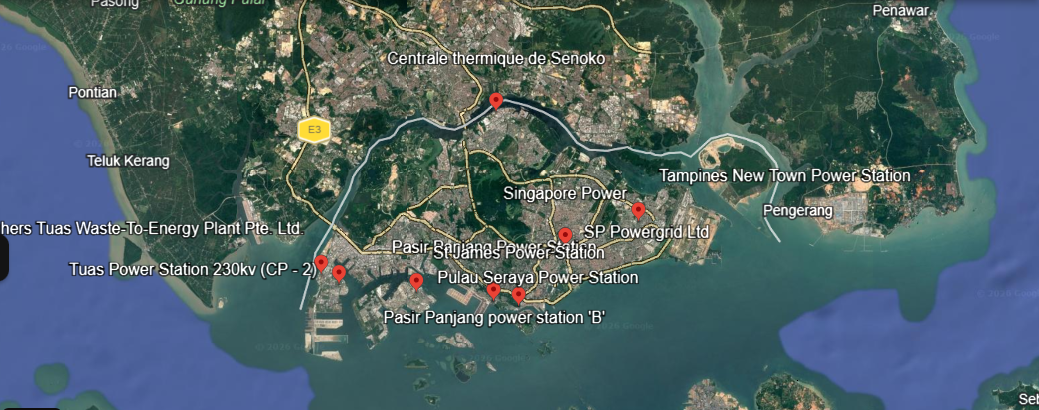
On paper, Singapore’s eight main power stations could pump out around 93.3 TWh a year if they ran flat-out at a 90% capacity factor. But real-world grid operations don't work on maximum theoretical limits. Plants need downtime for routine maintenance, unexpected outages happen, and system operators always hold back reserve capacity to absorb sharp swings in daily demand.
Because Singapore’s grid relies so heavily on Combined-Cycle Gas Turbines (CCGT), running these assets in the 70–80% load range represents the operational "sweet spot." Running the system in this 72.5 to 82.9 TWh range just makes sense. It strikes a gentle balance between keeping the turbines happy and efficient, without straining the hardware or blowing through operating budgets.
Annual Electricity Generation Calculation
Formula:
Annual Generation (TWh/year) = Installed Capacity (MW) × 8,760 (hours/year) × Capacity Factor ÷ 1,000,000
Installed Capacity: 11,827 MW
Examples:
-
70% Capacity Factor
11,827 × 8,760 × 0.70 ÷ 1,000,000 = 72.5 TWh/year -
80% Capacity Factor
11,827 × 8,760 × 0.80 ÷ 1,000,000 = 82.9 TWh/year -
90% Capacity Factor
11,827 × 8,760 × 0.90 ÷ 1,000,000 = 93.3 TWh/year
Geopolitical Risks to Singapore's Electricity Generation
With natural gas fueling over 93% of Singapore’s power generation, fuel security is a high-stakes balance. The island consumes between 9 and 10 billion cubic meters (320 to 350 billion cubic feet) of gas each year. Historically, the bulk of this arrived through regional pipelines from Indonesia and Malaysia. However, as mature Indonesian fields began to run low, pipeline deliveries naturally tapered off—forcing Singapore to lean much more heavily on seaborne Liquefied Natural Gas (LNG) shipped from farther afield, including Australia, Qatar, and the US.
Yet, swapping fixed pipelines for global shipping routes brings distinct vulnerabilities. Choke-point crises—such as potential blockades in the Strait of Hormuz freezing Qatari exports under force majeure—or logistics bottlenecks along long-haul US trade routes can quickly destabilize the supply chain.
The risks aren't purely operational; they are acutely financial—and directly threaten power generation itself. We saw how brittle this market can be following the Russia-Ukraine crisis, when the Asian LNG benchmark (JKM) surged nearly 32% in a single day—jumping from around $27.80 to $36.90/MMBtu—before skyrocketing past $80/MMBtu in early March 2022 (a massive 150%+ surge in just days).
For a grid so singularly dependent on natural gas, any severe breakdown in supply chains or explosion in fuel costs does not just inflate plant operating expenses; it risks undermining the very capacity to generate sufficient, reliable electricity for the entire nation.
For Singapore to maintain its edge as a global hub for data centers and cloud computing, it must aggressively scale back its overreliance on natural gas, which currently fuels more than 90% of its power grid. Betting almost everything on imported gas leaves the country fully exposed to geopolitical flare-ups and maritime choke-point disruptions—both of which drive up plant operating expenses and feed directly into electricity prices. Residential rates now sit around $0.23/kWh, while industrial rates linger close behind at $0.21/kWh. These figures are steep when compared to power-hungry markets competing for tech investment, such as Texas or the Gulf states.
To lower these costs, several energy alternatives are being weighed, with nuclear power naturally entering the conversation. While there are no legal or constitutional barriers in Singapore prohibiting nuclear energy, the primary roadblock is strictly technical and geographic. Given the island’s limited footprint and high population density, constructing traditional, large-scale nuclear reactors is essentially out of the question. A single major accident or radioactive containment failure—recalling Fukushima or Chernobyl—could render an entire country of this size uninhabitable.
However, nuclear power remains a viable option through an entirely different class of technology: transportable microreactors.
-
Westinghouse (eVinci™): Compact microreactors housed inside standard shipping containers. They generate between 5 to 10 MW and can run continuously for up to eight years without needing refueling or dedicated cooling water, making them a tailored fit for dedicated data center facilities.
-
Radiant (Kaleidos) and Last Energy: Ultra-safe micro-units built with passive safety mechanisms that automatically shut down during emergencies to eliminate the risk of radiation leaks.
Through manufacturing partnerships, deploying these microreactors could directly supply data centers, mining facilities, and heavy industrial plants, taking significant strain off the gas grid. Yet, for all their promise, microreactors are not yet a silver bullet—mainly because they have not been tested or commercially proven on a massive scale.
Meanwhile, biomass and biofuel solutions (like algae and organic waste) remain strictly limited. Despite Singapore’s strong research leadership in the field, these technologies have not translated into real-world applications capable of delivering the massive, utility-scale power required, and they remain cost-prohibitive.
Ultimately, the most practical alternative lies in cross-border renewable investments. By funding utility-scale solar and wind projects in land-rich neighboring countries like Indonesia and Malaysia, Singapore can import clean electricity through subsea high-voltage cables—much like the Sun Cable concept. Breaking its near-total dependence on natural gas is no longer just an environmental goal; it is a financial imperative if Singapore intends to keep its power costs competitive and retain the world's biggest tech and AI infrastructure investments.
How Singapore Plans to Diversify Its Power Grid and Cut Costs
-
Tapping into Neighboring Power Grids: Singapore is pushing to import 6 GW of low-carbon electricity by 2035—enough to cover roughly a third of its total energy needs. The plan relies on massive subsea cable links stretching to Indonesia, Malaysia, Cambodia, Vietnam, and Australia.
-
Setting Up SGEI: The government created a dedicated entity, Singapore Energy Interconnections (SGEI), to take charge of building and managing cross-border subsea cable infrastructure and plugging the island into the broader ASEAN grid.
-
Centralizing Gas Purchases (Singapore GasCo): Rather than letting individual utility companies buy gas on their own, Singapore is funneling all procurement through a single government buyer. This gives the country stronger leverage to negotiate better prices and shields local businesses and residents from wild price spikes.
-
Building a Second LNG Terminal: To make its fuel supply more resilient, Singapore is deploying a floating storage and regasification unit (FSRU) for a second LNG terminal. This will boost its import capacity by 50% by 2030 and provide a much-needed buffer during global supply squeezes.
-
Squeezing Value Out of Solar Space: Land is scarce, but Singapore is aiming for 2 GWp of solar capacity by 2030. To get there, it’s putting panels everywhere it can—covering rooftops, reservoirs like Tengen, and even calm offshore waters.
-
Prepping Plants for Hydrogen: All new gas-fired power plants are now required to run on hydrogen-ready turbines. The goal is to make a smooth pivot to green hydrogen as soon as global supply chains mature and costs come down.
-
Doing the Math on Next-Gen Nuclear: Through the Singapore Nuclear Research and Safety Initiative (SNRSI), the government is quietly funding deep-dive studies into small modular reactors (SMRs) to judge whether modern, micro-scale designs are safe and affordable enough for such a densely populated island.
-
Tightening Standards for Data Centers: Knowing how power-hungry tech infrastructure can be, the government has imposed strict energy efficiency rules on data centers while rolling out Virtual Power Plants (VPPs) to balance heavy demand spikes across the grid in real time.
Average Electricity Prices for Data Centers in Selected Locations
| Rank | Country / Region | Average Electricity Price (USD/kWh) | Lower than Singapore (%) | Notes |
|---|---|---|---|---|
| 1 | Abu Dhabi (UAE) | 0.074 | 64.8% | Large industrial off-peak tariff, suitable reference for data centers |
| 2 | Texas (USA) | 0.080 | 61.9% | Competitive wholesale electricity market (ERCOT) |
| 3 | India | 0.108 | 48.6% | Competitive electricity costs for large-scale data centers |
| 4 | Malaysia | 0.139 | 33.8% | Lower electricity costs, attractive for data center investments |
| 5 | Singapore | 0.210 | 0.0% (Reference) | LNG-dependent electricity market with relatively high electricity prices |
Analytical Note: The numbers here paint a clear picture: Singapore is facing a real competitive squeeze when it comes to powering data infrastructure. Operators setting up in markets like Abu Dhabi or Texas spend less than a third of what they would pay in Singapore. Even right across the causeway, Malaysia’s 33.8% discount on electricity—combined with cheaper land—has made Johor an aggressive alternative, pulling heavy workload investments away from the island state.
Methodology & Data Sources
This analysis draws on official energy data, power generation stats, and electricity tariff databases from government agencies and global industry bodies. Where direct metrics weren't readily available—such as converting installed power capacity into yearly output estimates—we applied standard energy sector capacity factors and standard engineering math. All future projections, regional comparisons, and strategic interpretations in this piece represent independent analysis and should be read as operational insights rather than official government policy.