
Introduction
The way the world handles energy is shifting. Making sure the power stays on is now just as big of a deal as producing it. Because of the massive pull from data centers, AI, manufacturing, and just modern life in general, we need huge amounts of dependable power that runs flawlessly around the clock.
While solar and wind energy are playing a much bigger role in powering our grids today, they're still entirely at the mercy of the weather. Hydropower is similarly affected by water availability. Nuclear power offers a fundamentally different model: large-scale electricity generation that can operate continuously, independent of daylight, wind conditions, or rainfall.
This is where Rosatom, Russia’s state nuclear corporation, has established a particularly strong international position.
Rosatom is not simply a company that builds nuclear reactors. Its activities extend across uranium, uranium enrichment, nuclear fuel, reactor technology, engineering, construction, training, operation support, maintenance, and other energy-related technologies. The company has also expanded into areas such as wind power, energy storage, composite materials, and digital solutions.
Its international projects are perhaps the clearest demonstration of its strength. In Türkiye, Egypt, and Bangladesh, Rosatom is implementing major nuclear projects based on its VVER-1200 reactor technology. These projects are not simply power plants: they create long-term technological and energy relationships between Russia and the countries hosting them.
That raises a much broader question.
Can Rosatom become one of the world's most important providers of nuclear electricity while simultaneously becoming a strategic instrument of Russian energy diplomacy?
1. Rosatom: From Russia’s Nuclear Industry to a Global Power
A long nuclear history
Rosatom's history is inseparable from the development of Russia's nuclear industry.
The Soviet nuclear program created extensive expertise in reactor design, uranium processing, enrichment, nuclear fuel, and nuclear power generation. Over decades, these capabilities developed into a broad industrial ecosystem covering much of the nuclear value chain.
Rosatom was established in its present state-corporation structure in 2007, bringing major elements of Russia's civilian nuclear industry under one organization.
This structure gave Rosatom an important advantage: it could participate in several stages of a nuclear project rather than simply selling reactor technology.
A nuclear power plant requires far more than the reactor itself. It requires engineering, procurement, construction, equipment, fuel, highly trained personnel, safety systems, maintenance, technical support, and long-term operational expertise.
Rosatom's integrated structure allows it to provide many of these services within the same broader corporate ecosystem.
That is one of the reasons its international model has become so significant.
2. Beyond Nuclear Power
Nuclear energy remains Rosatom's core activity, but the corporation's business interests are broader.
Rosatom has developed activities in wind energy, and it has also worked on energy-storage systems, innovative composite materials, and digital solutions.
Its wind-energy activities demonstrate an attempt to participate in the wider transition toward low-carbon energy rather than relying exclusively on nuclear generation.
However, nuclear technology remains the company's defining strength.
The most strategically important part of its business is the ability to combine reactor design, construction, fuel supply, engineering, training, and long-term technical support.
This creates a model in which the relationship between Rosatom and a foreign country can continue for decades after the construction phase has ended.
3. Rosatom and the Nuclear Fuel Chain
A nuclear company cannot be evaluated simply by counting the reactors it builds.
The nuclear fuel chain is equally important.
Russia has developed extensive capabilities in uranium processing and enrichment, as well as nuclear-fuel production. These capabilities provide Rosatom with an important position beyond the construction site itself.
The nuclear relationship therefore begins before the reactor starts generating electricity.
Uranium must be processed and enriched. Fuel must be manufactured. The fuel must be compatible with the reactor design. Operators must be trained, equipment must be maintained, and technical services must remain available throughout the plant's operating life.
This is why nuclear cooperation can create relationships that last for decades.
For the customer, this integrated model can simplify the development of a nuclear program.
For Russia, however, it also creates a long-term international presence in strategically important energy systems.
That becomes especially important when geopolitical tensions affect trade, finance, technology transfers, equipment, and fuel supplies.
4. Rosatom’s Global Nuclear Model
Rosatom's international strategy goes considerably beyond exporting a reactor.
Depending on the project, the company's involvement can include:
-
Engineering and design
-
Procurement
-
Construction
-
Equipment supply
-
Nuclear-fuel supply
-
Training
-
Commissioning
- Operation support
-
Maintenance
-
Technical services
-
Spent-fuel-related services
This integrated model can be seen particularly clearly in three major projects: Akkuyu in Türkiye, El-Dabaa in Egypt, and Rooppur in Bangladesh.
Each project is different, but all three demonstrate how Russian nuclear technology is being integrated into national electricity systems outside Russia.
5. Akkuyu: Rosatom’s Nuclear Project in Türkiye
Rosatom has a lot riding on the Akkuyu Nuclear Power Plant—it’s a huge deal for them internationally. Once fully up and running, its four VVER-1200 reactors will generate an impressive 4,800 MW of electricity. Since these use Russia's top-tier Generation III+ technology, they're incredibly advanced. But the biggest takeaway here is what this means for Türkiye: it's an absolute game-changer. Instead of leaning entirely on fossil fuels and renewables like they always have, they're finally adding heavy-duty nuclear power to the mix.
Contract and implementation
The Russian-Turkish nuclear cooperation framework dates back to 2010, while the project subsequently progressed through preparation, construction, installation, commissioning, and licensing stages.
The four units are being brought into operation progressively rather than simultaneously.
The significance of Akkuyu is not limited to the 4.8 GW installed capacity.
Türkiye generated 332.9 TWh of electricity in 2024. If the four reactors were to operate at their theoretical maximum continuously throughout the year, their maximum annual generation would be:
4.8 GW × 8,760 hours = 42.048 TWh
Compared with Türkiye's 2024 electricity generation:
42.048 ÷ 332.9 × 100 = 12.63%
Therefore, the plant's theoretical maximum annual output corresponds to approximately 12.6% of Türkiye's 2024 electricity generation.
This is a theoretical calculation, not a forecast of actual annual generation. Actual output will depend on capacity factor, maintenance, outages, and operating conditions.
The important point is that a 4.8 GW nuclear facility can represent a very substantial addition to Türkiye's electricity system.
The plant can provide continuous generation independently of whether the sun is shining or the wind is blowing.
Table 1 — Akkuyu Nuclear Power Plant, Türkiye
| Technical Parameter | Details / Calculation |
|---|---|
| Country | Türkiye |
| Project | Akkuyu Nuclear Power Plant |
| Technology | Russian VVER-1200 Pressurized Water Reactor (PWR), Generation III+ |
| Number of reactors | 4 units |
| Capacity per reactor | 1,200 MW |
| Total installed capacity | 4 × 1,200 = 4,800 MW (4.8 GW) |
| Operating model | Continuous baseload electricity generation |
| Theoretical maximum annual generation | 4.8 GW × 8,760 hours = 42.048 TWh/year |
| Türkiye electricity generation (2024) | 332.9 TWh |
| Theoretical share of 2024 generation | 42.048 ÷ 332.9 × 100 = 12.63% |
| Design life | 60 years |
| Strategic role | Diversification of Türkiye's electricity supply and addition of large-scale baseload generation |
| Important qualification | 12.63% is a theoretical maximum comparison, not a forecast of actual annual generation. Actual output depends on capacity factor, maintenance, refueling and outages. |
6. El-Dabaa: Rosatom’s Nuclear Expansion in Egypt
Egypt's El-Dabaa Nuclear Power Plant represents another major element of Rosatom's international strategy.
The country's efforts to introduce nuclear power began decades ago. The site-selection process dates back to the late 1970s, followed by feasibility studies and different attempts to establish the project.
The current El-Dabaa project consists of four 1,200 MW VVER-1200 units, giving the plant a total capacity of 4,800 MW.
The project owner and operator is Egypt's Nuclear Power Plants Authority (NPPA), while entities belonging to the Rosatom group are responsible for major elements of engineering, procurement and construction, nuclear-fuel supply, operation support, maintenance, and spent-fuel treatment.
The plant is located on Egypt's northern Mediterranean coast.
Contract and implementation
The first major preparation stage began in December 2017. The implementation process is divided into preparation, construction, installation, training, commissioning, testing, and licensing.
The project is particularly important because the selected reactor belongs to the Generation III+ category and is based on the VVER-1200 design.
According to the project information provided, the design incorporates post-Fukushima safety requirements and gives safety and reliability a central role.
Egypt generated 218.5 TWh of electricity in 2024.
The four reactors have a combined capacity of 4.8 GW. At theoretical maximum operation:
4.8 GW × 8,760 hours = 42.048 TWh per year
Compared with Egypt's 2024 generation:
42.048 ÷ 218.5 × 100 = 19.24%
Therefore, the theoretical maximum annual electricity output of El-Dabaa corresponds to approximately 19.2% of Egypt's 2024 electricity generation.
Again, this is not an estimate of actual plant production. It is a maximum theoretical comparison based on continuous operation at full rated capacity.
The significance is nevertheless considerable.
Egypt's electricity generation remains heavily dependent on fossil fuels. El-Dabaa therefore has the potential to diversify the electricity system while preserving valuable oil and gas resources for other uses.
The project is also expected to support technology transfer, research and development, workforce development, and greater localization of industrial activities.
The information provided for the project indicates a localization target of at least 20% for the first unit, rising to as much as 35% for the fourth unit.
Table 2 — El-Dabaa Nuclear Power Plant, Egypt
| Technical Parameter | Details / Calculation |
|---|---|
| Country | Egypt |
| Project | El-Dabaa Nuclear Power Plant |
| Technology | Russian VVER-1200 Pressurized Water Reactor (PWR), Generation III+ |
| Number of reactors | 4 units |
| Capacity per reactor | 1,200 MW |
| Total installed capacity | 4 × 1,200 = 4,800 MW (4.8 GW) |
| Project implementation began | December 2017 |
| Planned construction stage | 5.5 years |
| Commissioning and testing stage | 11 months |
| Design generation | Generation III+ |
| Theoretical maximum annual generation | 4.8 GW × 8,760 hours = 42.048 TWh/year |
| Egypt electricity generation (2024) | 218.5 TWh |
| Theoretical share of 2024 generation | 42.048 ÷ 218.5 × 100 = 19.24% |
| Project owner / operator | Egypt's Nuclear Power Plants Authority (NPPA) |
| Main contractor | Entities of the Rosatom group |
| Strategic role | Diversification of electricity sources, reduction of dependence on oil and gas, and development of nuclear capabilities |
| Important qualification | 19.24% is a theoretical maximum comparison, not a forecast of actual annual generation. |
7. Rooppur: Rosatom’s Nuclear Project in Bangladesh
Bangladesh's Rooppur Nuclear Power Plant has one of the longest histories among the three projects.
The decision to construct a nuclear power plant in the country dates back to 1961. Multiple feasibility studies were subsequently carried out during both the pre-independence and post-independence periods.
Several governments approved the project at different stages, while attempts were made to secure international financing and technological partners.
A major breakthrough came in 2010, when Bangladesh and Russia signed a framework agreement on peaceful nuclear cooperation.
An intergovernmental agreement followed in 2011.
In 2015, the Bangladesh Atomic Energy Commission and Russia's Atomstroyexport signed the general construction contract for the project, valued at $12.65 billion.
Rooppur consists of two VVER-1200 reactors, each with a capacity of 1,200 MW.
The total installed capacity is therefore:
1.2 GW × 2 = 2.4 GW
Contract and implementation
The major milestones include:
-
Framework agreement: 21 May 2010
-
Intergovernmental agreement: 2 November 2011
-
General construction contract: 25 December 2015
-
Two reactors
-
Total capacity: 2,400 MW
-
Reactor technology: VVER-1200
The contract includes equipment supply and installation, commissioning, trial operation, training of Bangladeshi personnel, and initial nuclear-fuel supply.
Bangladesh generated 101.7 TWh of electricity in 2024.
At theoretical maximum continuous operation, the two reactors could generate:
2.4 GW × 8,760 hours = 21.024 TWh per year
Compared with Bangladesh's 2024 electricity generation:
21.024 ÷ 101.7 × 100 = 20.67%
The theoretical maximum annual generation of Rooppur therefore corresponds to approximately 20.7% of Bangladesh's 2024 electricity generation.
This is an especially significant figure because Bangladesh has a much smaller electricity-generation base than Türkiye or Egypt.
The project could therefore have a major structural effect on the country's electricity mix.
Bangladesh's electricity generation is also overwhelmingly dependent on fossil fuels, making the introduction of 2.4 GW of nuclear capacity potentially important for diversification and long-term electricity security.
Table 3 — Rooppur Nuclear Power Plant, Bangladesh
| Technical Parameter | Details / Calculation |
|---|---|
| Country | Bangladesh |
| Project | Rooppur Nuclear Power Plant |
| Technology | Russian VVER-1200 |
| Number of reactors | 2 units |
| Capacity per reactor | 1,200 MW |
| Total installed capacity | 2 × 1,200 = 2,400 MW (2.4 GW) |
| Framework Agreement | 21 May 2010 |
| Intergovernmental Agreement (IGA) | 2 November 2011 |
| General Construction Contract | 25 December 2015 |
| Construction contract value | US$12.65 billion |
| Theoretical maximum annual generation | 2.4 GW × 8,760 hours = 21.024 TWh/year |
| Bangladesh electricity generation (2024) | 101.7 TWh |
| Theoretical share of 2024 generation | 21.024 ÷ 101.7 × 100 = 20.67% |
| Contract scope | Construction, equipment supply and installation, commissioning, trial operation, personnel training and initial nuclear-fuel supply |
| Initial nuclear-fuel supply | First three years |
| Strategic role | Large-scale baseload generation and diversification of Bangladesh's heavily fossil-fuel-dependent electricity system |
| Important qualification | 20.67% is a theoretical maximum comparison, not a forecast of actual annual generation. |
8. KEPCO: South Korea’s Challenge to Russia’s Nuclear Export Model
Rosatom is powerful, but it is not alone.
One of the most important competitors to emerge in the international nuclear market is Korea Electric Power Corporation (KEPCO).
The strongest example of South Korea's international nuclear capabilities is the Barakah Nuclear Energy Plant in the United Arab Emirates.
This project is particularly important because it demonstrates that a country other than Russia has successfully exported a modern nuclear reactor design, constructed multiple units overseas, and brought them into commercial operation.
The Barakah project
In December 2009, a consortium led by KEPCO won the contract to build four nuclear reactors in the UAE.
The project uses South Korea's APR1400 reactor technology.
The four units have a combined capacity of:
1,400 MW × 4 = 5,600 MW
This makes Barakah one of the largest nuclear projects built by a Korean-led consortium outside South Korea.
KEPCO's role went beyond simply supplying reactor technology. The company's overseas business model involved construction and broad project support, demonstrating that Korean nuclear expertise could be exported as an integrated infrastructure package.
The APR1400 is a pressurized water reactor developed as an evolution of Korea's earlier nuclear technology. It has a design life of 60 years and a net electrical capacity of approximately 1,400 MWe per unit.
The four Barakah units entered commercial operation progressively:
-
Unit 1 — 2021
-
Unit 2 — 2022
-
Unit 3 — 2023
-
Unit 4 — 2024
By September 2024, all four units had entered commercial operation.
This is strategically important when evaluating Rosatom.
The Barakah experience shows that nuclear technology exports are not necessarily a Russian monopoly. South Korea has demonstrated the ability to transfer its domestic nuclear technology to another country, construct a four-unit complex, and bring it into commercial operation.
The UAE project therefore provides a genuine international benchmark against which Rosatom's overseas performance can be assessed.
9. Nuclear Power as Energy Diplomacy
Nuclear projects are fundamentally different from many other energy projects because their relationships with host countries can last for decades.
A nuclear reactor is not simply purchased, installed, and forgotten.
The operator needs fuel, technical expertise, trained personnel, maintenance, spare parts, safety support, and specialized services.
This means that the company supplying the technology can remain an important partner long after construction has ended.
For Rosatom, this creates an opportunity to develop long-term energy relationships with countries seeking to expand nuclear power.
This raises a broader geopolitical question:
Can peaceful nuclear technology become a new form of Russian energy diplomacy?
The answer depends on how countries balance the advantages of reliable nuclear generation against the strategic risks associated with dependence on a foreign technology provider.
Türkiye, Egypt, and Bangladesh provide three important examples of this relationship.
In each case, Rosatom is not simply supplying a reactor. It is participating in a much broader technological and industrial relationship.
10. Sanctions: A New Risk for Rosatom’s International Expansion
The geopolitical environment has become one of the biggest challenges facing Russia's international nuclear industry.
Following Russia's war against Ukraine, the United States and other Western governments imposed extensive sanctions on Russian individuals, companies, financial institutions, and strategic industries.
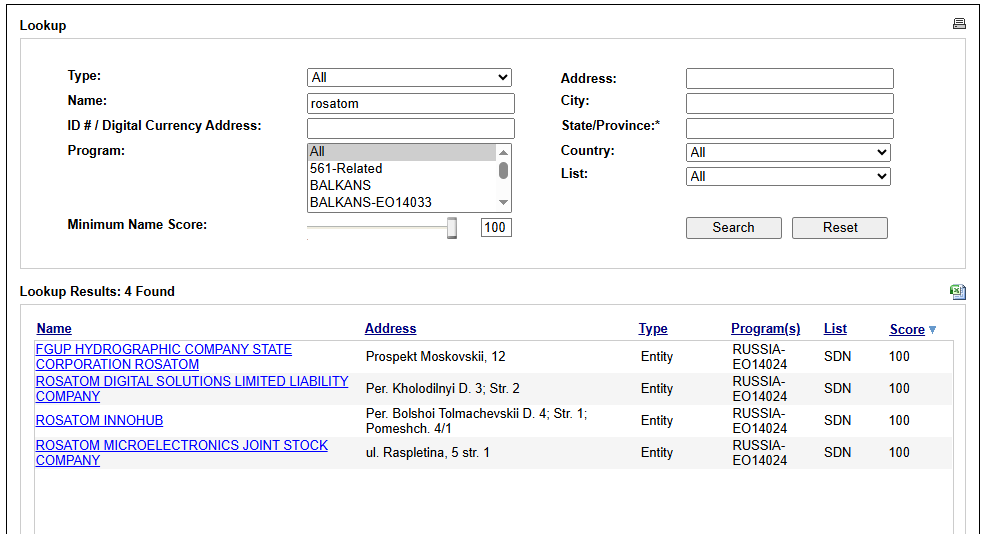
Rosatom and entities within its wider corporate ecosystem have also been affected by U.S. sanctions measures.
The U.S. Office of Foreign Assets Control (OFAC) provides the official sanctions records through its sanctions programs and designations. OFAC records confirm the designation of several entities connected to the broader Rosatom ecosystem, including entities such as Rosatom Digital Solutions LLC and Rosatom Microelectronics JSC. U.S. Treasury — OFAC Recent Actions
This distinction is important.
It is not accurate to treat every Rosatom-related entity as automatically subject to identical restrictions. Sanctions can apply to specific subsidiaries, affiliates, transactions, individuals, or activities.
Nevertheless, the existence of sanctions creates potential risks for the international nuclear business.
These risks can involve:
-
International financing
-
Payments
-
Equipment imports and exports
-
Shipping
-
Insurance
-
Spare parts
-
Engineering services
-
Technology transfers
-
Supply chains
Nuclear-fuel transactions
The impact on a project depends on exactly which entity is sanctioned, what transaction is involved, what licenses or exemptions apply, and how advanced the project is.
This distinction is particularly important when considering Akkuyu, El-Dabaa, and Rooppur.
A sanction does not automatically mean that an operating nuclear power plant will suddenly stop producing electricity.
However, restrictions can potentially make future projects more difficult, increase transaction costs, complicate equipment procurement, or create delays in international supply chains.
11. Could These Nuclear Plants Operate Without Rosatom?
This question becomes increasingly important as nuclear cooperation becomes more geopolitical.
A reactor built around a specific technology cannot simply be separated from its original technological ecosystem overnight.
The same applies to nuclear fuel.
Sure, you might find alternative vendors for certain parts or fuel tech, but making the switch is far from plug-and-play. It takes rigorous compatibility testing, endless regulatory green lights, and heavy engineering adjustments to pull it off.
The same principle applies to specialized equipment and spare parts.
Therefore, the existence of alternative suppliers does not automatically mean that a country can immediately replace the original supplier.
For countries operating Russian-designed reactors, the strategic objective could instead be gradual diversification of supply chains wherever technically and legally possible.
That could reduce long-term dependence while preserving the ability to operate the plant safely.
The distinction between a new project and an existing reactor is also critical.
A future project that has not yet entered construction may be much more vulnerable to sanctions, financing restrictions, and supply-chain disruptions than a reactor that has already been completed and is generating electricity.
Conclusion
Nuclear power is far more than just a way to generate electricity on a large scale; it acts as a stabilizing backbone for a country’s entire energy grid. Because it provides a constant, reliable flow of power with predictable operating costs, it shields economies from the erratic swings in fuel prices and the supply shocks that often follow geopolitical unrest. This level of reliability is a game-changer for energy-intensive industries. When power costs become unpredictable and expensive, it erodes a company’s ability to compete and inflates production expenses, eventually pushing manufacturers to pack up and move to regions where energy is more affordable.
Russia was among the countries that recognized the strategic potential of exporting nuclear technology through Rosatom. Its model extends far beyond reactor construction: it can involve feasibility studies, engineering, construction, personnel training, commissioning, operation support, nuclear-fuel supply, maintenance, and long-term technical services. This creates relationships that can potentially last for decades and makes nuclear cooperation fundamentally different from a conventional energy transaction.
The question, therefore, is no longer simply whether Rosatom can build nuclear power plants abroad. It is whether nuclear technology can become a new instrument of Russian international influence—a strategic asset capable of creating long-term partnerships through energy security, industrial cooperation, and technological dependence.
This question becomes even more significant as Russia's traditional influence through arms exports faces increasing pressure. SIPRI reports that Russia's share of global major-arms exports fell from 21% in 2016–20 to 6.8% in 2021–25, while China's position in the global arms market continues to strengthen.
Rosatom may therefore represent something much larger than Russia's nuclear industry. It could be an attempt to build a new economic and geopolitical lever—one based not on weapons, but on the infrastructure that keeps modern economies powered. The ultimate question is whether Rosatom can slow the erosion of Russia's international influence by turning nuclear energy into a new engine of diplomacy
Frequently Asked Questions (FAQ)
Q1: Is Rosatom limited to building nuclear reactors for electricity generation?
No. Rosatom's work goes well beyond building nuclear reactors. The corporation is involved across much of the nuclear fuel cycle, including uranium processing and enrichment, nuclear-fuel production, reactor construction, technical support, and personnel training. It is also involved in areas such as radioactive-waste management, wind power, energy storage, composite materials, and digital technologies.
Q2: Is Rosatom building nuclear reactors outside Russia?
Yes. Rosatom is involved in major nuclear projects outside Russia, including Akkuyu in Türkiye, El-Dabaa in Egypt, and Rooppur in Bangladesh. Together, these three projects involve 10 VVER-1200 reactors with a combined installed capacity of 12 GW.
Akkuyu and El-Dabaa each consist of four 1,200 MW reactors, while Rooppur consists of two. These projects illustrate the scale of Rosatom's international nuclear business and its role in developing long-term nuclear partnerships with other countries.
Q3: Is Rosatom owned by the Russian state?
Yes. Rosatom is a Russian state corporation established under Federal Law No. 317-FZ in 2007. The law was signed by President Vladimir Putin on 1 December 2007, creating the state corporation that brought major parts of Russia's civilian nuclear industry under a single institutional structure.
Q4: Has the United States imposed sanctions on Rosatom since the start of the war in Ukraine?
Yes. The United States has imposed sanctions on Rosatom and certain entities within its broader corporate group following Russia's invasion of Ukraine. However, the restrictions do not automatically apply in exactly the same way to every Rosatom-related entity, subsidiary, transaction, or activity. The scope of the sanctions depends on the specific entity or activity involved and the applicable U.S. sanctions rules and authorizations.
References
Egyptian Nuclear Power Plants Authority (NPPA). El-Dabaa Nuclear Power Plant Project Overview. Bangladesh Atomic Energy Commission (BAEC). Rooppur Nuclear Power Plant Project Overview. U.S. Department of the Treasury, Office of Foreign Assets Control (OFAC). Sanctions Programs and Designations. European Commission, Joint Research Centre (JRC). Technical Assessment of Nuclear Energy Under the EU Taxonomy Regulation. 2021. Korea Electric Power Corporation (KEPCO). Overseas Nuclear Business. Worldometer. Turkey Electricity — 2024. Worldometer. Egypt Electricity — 2024. Worldometer. Bangladesh Electricity — 2024. 2024 electricity-generation figures are based on Worldometer data and are used for theoretical generation-share calculations.