
INTRODUCTION
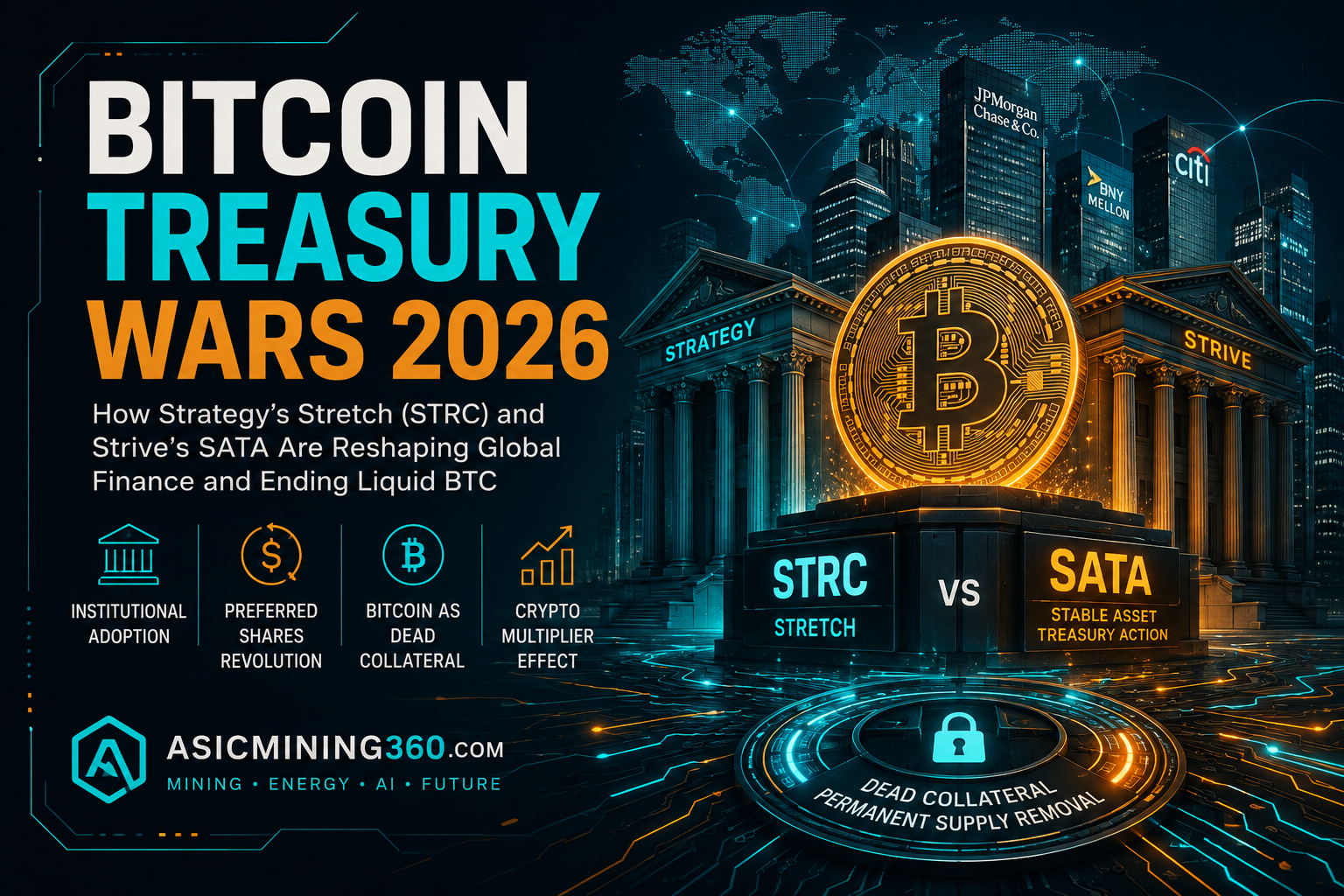
The financial landscape of 2026 is no longer defined by the erratic bull vs. bear narratives of the past decade. Instead, we have entered the era of the Bitcoin Treasury Company (BTC)—a sophisticated evolution where Bitcoin isn't just an asset to be traded, but the bedrock upon which a new global credit system is being engineered. As someone who has managed ASIC mining farms and navigated the cold storage shifts since the early days, I can tell you that what we are witnessing with Michael Saylor’s Stretch and Strive’s SATA is the most significant transformation of capital since the end of the Gold Standard.
Understanding the Stretch Model: How Strategy Bitcoin Leverages Preferred Shares for Aggressive BTC Accumulation
On July 25, 2025, a paradigm shift occurred. Strategy Bitcoin launched its Stretch Preferred Action (STRC), fundamentally altering the DNA of institutional Bitcoin acquisition. To the uninitiated, it looks like a simple high-yield instrument, but to those of us who understand the "plumbing" of finance, it is a masterstroke of monetary capture. The "Stretch" was designed to solve a singular problem: Volatility. While Bitcoin’s long-term trajectory is up, its short-term fluctuations deter massive pools of lazy capital (pension funds, insurance companies, and retirees). By offering a fixed dividend of approximately 11%, Strategy Bitcoin created a buffer. When the demand for this yield drives the STRC price above its $100 par value, the company initiates its At-The-Market (ATM) program. This is essentially a high-velocity capital recycler. In the first six months of its existence, this mechanism facilitated over $10.5 billion in volume. When the STRC trades at a premium, Saylor issues more shares, collects USD from investors seeking stability, and immediately converts that USD into Bitcoin. This isn't just buying; it's a structural mandate. We saw this ATM trigger with clinical precision in November 2025 and again in early January 2026, propelling Strategy Bitcoin’s holdings to a staggering 715,000 BTC, nearly eclipsing the passive holdings of the BlackRock ETF.
The Inverted Pyramid of Risk: Why Global Major Banks Are Shifting Toward Bitcoin Treasury Structures
To truly grasp the 2026 market, one must revisit the Exeter Inverted Pyramid of Risk. Historically, the base of the pyramid—the most liquid, lowest-risk asset—was gold, and later, the US Dollar. However, since the post-2008 era, the "trust" in the dollar as the ultimate reserve has been eroding. In 2026, we are seeing Bitcoin Treasury Companies position themselves as the new Reserve Institutes at the very tip of this inverted pyramid. Why are giants like BNY Mellon, Citigroup, and JPMorgan suddenly vocal supporters? Because they need a foundation for credit that isn't tied to the debasement of fiat. A bank’s commercial offerings—mortgages, term accounts, life insurance—are built on short-term fixed-income products. Traditionally, these were Treasury Bills. But in an environment of persistent inflation and geopolitical shifts, T-bills are no longer enough. Michael Saylor isn't competing with banks; he is becoming their primary supplier of high-integrity collateral. By holding Bitcoin and issuing Stretch instruments, he provides banks with a Short-Term Fixed Income product that is backed by the hardest asset on the planet. As of this year, 8 out of the top 10 US banks have integrated crypto-lending, a 180-degree shift from the hostility of 2023.
Analyzing Bitcoin Price Inelasticity and the Crypto Multiplier Effect on Institutional Markets in 2026
One of the most profound technical aspects of Bitcoin in 2026 is its Price Inelasticity. In traditional equity markets, when capital flows into a stock, the company can dilute the price by issuing more shares. Bitcoin, governed by immutable code, has no such "release valve." Furthermore, roughly 74% of all Bitcoin is currently immobile—held in institutional vaults, deep cold storage, or lost forever. This creates a tiny liquid float. When a vehicle like the STRC or SATA enters the market to buy Bitcoin, it doesn't just impact the price linearly; it triggers the Crypto Multiplier. Research from analysts like Adam Livingstone suggests that in 2026, the multiplier sits between 5x and 10x. This means for every $1 billion of capital that enters a Bitcoin Treasury and gets "locked away" as dead collateral, the total market capitalization of Bitcoin increases by $5 billion to $10 billion. This is why the Stretch is so explosive. Unlike an ETF, where an investor can sell and force the fund to dump BTC back onto the market, the Bitcoin captured by a Treasury Company is unidirectionally removed. It goes into a monetary black hole and stays there, permanently thinning the supply and forcing the next buyer to pay an exponentially higher price.
STRC vs SATA: How Strive and Strategy Bitcoin Are Competing for Dominance in the Bitcoin Treasury Market
If Strategy Bitcoin were the only player, we might dismiss this as a one-man crusade. But the entrance of Strive, co-founded by Vivek Ramaswamy, validates the entire sector. Strive’s SATA (Stable Asset Treasury Action) is a direct challenger to the Stretch, using a similar architecture to capture bond-market liquidity. The competition between STRC and SATA is healthy for the ecosystem. It provides managerial diversification for investors. While Saylor is the pioneer, Strive targets a different demographic—those focused on Shareholder Primacy and anti-ESG mandates. This dual-pronged attack on the bond market is attracting what we call Slow Capital. These aren't speculators looking for a 10x return; these are pension fund managers looking for a safe 7-9% yield. They don't care about Bitcoin’s price; they care about the coupon. But by chasing that coupon, they are inadvertently funding the greatest supply squeeze in history.
Bitcoin as Dead Collateral: How Institutional Absorption Is Forcing the End of Liquid BTC Supply
As we look at the data for early 2026, we see that the STRC alone absorbed nearly 81% of all newly mined Bitcoin in a single week. When you add the SATA and other treasury mimics, the total absorption rate often exceeds 100% of new issuance. This leads us to the Silent IPO phase of Bitcoin adoption. We have moved past the Early Adopters who bought BTC on exchanges. We are now in a phase where Bitcoin is being "uploaded" into the institutional balance sheets. Once it is there, it becomes Dead Collateral—assets that are never intended to be sold, but rather used to back the issuance of new, stable forms of money. In this scenario, the volatility of Bitcoin isn't a bug; it's a feature for the Treasury Company. As the value of the underlying BTC grows (at a projected 25-30% CAGR), the company’s ability to pay out 11% dividends becomes even more secure. It’s a self-reinforcing loop:
-
Issue yield-bearing shares.
-
Buy Bitcoin with the proceeds.
-
Bitcoin price rises due to supply shock.
-
The balance sheet strengthens, allowing for more share issuance.
Forecasting the Path to $1 Million Bitcoin: The Impact of Money Market Funds and Fixed Income Capital Migration
To those who ask why Bitcoin hasn't hit $500k or $1M yet, the answer lies in the Money Market Funds. In the US alone, these funds hold over $7.7 trillion. This capital is parked, waiting for a safe harbor. If just 1% of the US Money Market migrates into Bitcoin Treasury instruments like the Stretch to find a better yield than T-bills, that would be an inflow of $77 billion. Applying our 2026 multiplier of 7x, that single move would add over half a trillion dollars to Bitcoin’s market cap. This isn't hopium; it is arithmetic. The market for Fixed Income is roughly $145 trillion globally. Bitcoin is the only asset with the scarcity and transparency to eventually replace the sovereign bond as the risk-free rate of the digital age.
Investor Strategy Guide: How to Position Your Portfolio for the Great Bitcoin Treasury Absorption
As a practitioner who has seen the transition from mining with GPUs to managing sophisticated ASIC fleets and now analyzing treasury structures, my advice is clear: Stop looking at the daily candles and start looking at the balance sheets. We are approaching a point where a handful of entities will own the majority of the liquid Bitcoin. These entities will be the most credible financial institutions of the 21st century. They will issue the credit, they will provide the stability, and they will control the reserve.
Next Steps for the Investor:
-
Diversify into Yield: If you are over-exposed to the volatility of spot BTC, consider allocating a portion to Treasury-backed instruments (STRC/SATA) to secure a fixed income while still benefiting from the structural price floor they provide.
-
Maintain Self-Custody: Never forget the core tenet of Bitcoin. While these instruments are genius for wealth generation, your emergency reserve must always remain in a cold wallet you control.
-
Monitor the "ATM" Windows: Watch the premium of these stocks. When they trade significantly above par, it signals a massive buy order for Bitcoin is imminent. The Great Absorption is here. Bitcoin is being pulled off the market at a rate that the 21-million-coin limit never anticipated for this early in the game. You can either be a spectator or you can secure your place in the new pyramid.
FAQ
Q1: Why does a Bitcoin Treasury Company actually want "Dead Collateral"?
Answer: Most people think assets should always be moving. But in our world, Dead Collateral is our superpower. When we lock Bitcoin away in deep cold storage, we’re essentially taking it out of the hands of speculators and turning it into a permanent, unshakeable foundation for institutional credit. We don't want to trade it; we want to build a new global financial system on top of it.
Q2: Is the "Crypto Multiplier Effect" just fancy math, or is it real?
Answer: It’s very real, and it’s all about supply and demand dynamics. Think of it this way: because Bitcoin’s supply is capped at 21 million, and most of it is already held by long-term HODLers, the liquid float is tiny. When a company buys $1 billion worth to hold forever, we are shrinking the pool for everyone else. That supply squeeze forces the market capitalization to jump much higher than the actual dollar amount spent.
Q3: Why would I buy a Treasury Instrument instead of just buying Spot Bitcoin myself?
Answer: Great question. Buying Spot Bitcoin is like owning a bar of gold—it’s great, but it just sits there. Our yield-bearing instruments (like the STRC or SATA) turn that "gold" into a productive engine. You get a fixed dividend or a steady coupon while the company manages the Bitcoin accumulation and navigates the market volatility. It’s for the investor who wants the security of Bitcoin but needs the cash flow of a traditional fixed-income product.
Q4: What happens to the Bitcoin Treasury if the price drops 50% tomorrow?
Answer: We actually breathe easier. For a Bitcoin Treasury Company, volatility is a feature, not a bug. Our structures are built with massive buffers to handle black swan events. Because we focus on the long-term CAGR and use At-The-Market (ATM) programs to fund our buys, a temporary dip is just an opportunity to stabilize the balance sheet. We aren't checking the price to sell; we’re monitoring the structural floor to lead the next accumulation phase.